
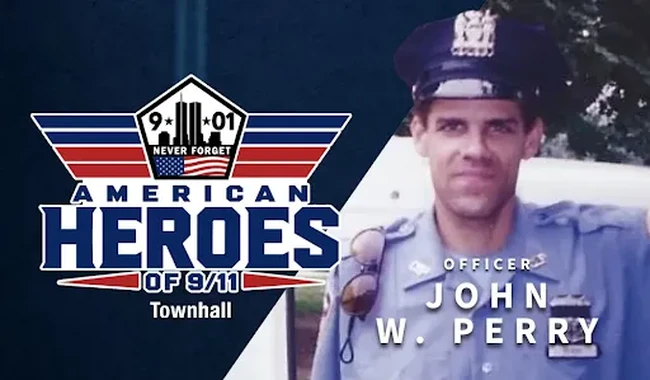
As we approach the 25th anniversary of the September 11 terrorist attacks against the United States, Townhall plans to honor the lives lost and the lives forever changed with our "Heroes of 9/11" series. Every day from now until September 11, we will highlight an American hero. This year, most especially, we wish not simply to commemorate an event, but the character of exceptional men and women who demonstrated the best of humanity in one of its darkest moments. More than that, we want to educate younger generations for whom September 11 is little more than a historical episode so that we embody what it means to "Never Forget."
Officer John W. Perry had already turned in his badge. After spending eight years with the NYPD, Perry was leaving the force to return to law and already had a job lined up with a Manhattan law firm.
Then Perry heard the first plane had struck the World Trade Center. He reclaimed his badge, got an NYPD shirt, and headed to Lower Manhattan to help his fellow officers.
But that's just part of Perry's story. When he was in the first grade, he was diagnosed with learning disabilities and spent many years in special education classrooms. He didn't learn to tie his shoes until he was nine. Despite that adversity, Perry found a love of languages, starting with French in the eighth grade. He would go on to speak French, Russian, Spanish, Swedish, and Portuguese.
Perry finished law school and ran multiple marathons. On September 9, 2001, he spent the day driving around with Norman Siegel, the former New York Civil Liberties Union official who was running for public advocate. "We spent September 9 driving around in his car as he made campaign announcements in English and Spanish," Siegel recalled. "I was convinced he would run for office himself one day."
Being a police officer, a polyglot, and a selfless man wasn't enough for Perry. He also appeared in TV shows and movies, including the groundbreaking "NYPD Blue," "The Devil's Advocate," and "Die Hard with a Vengeance."
Perry was known for his generosity, too. Vladimir Azbel, a longtime friend, said he once called Perry because he had $1,700 in parking tickets. "He said, 'Yeah, don't worry. Just don't get anymore tickets,'" Azbel said. "Later on I found out that he just paid them." Perry's two-bedroom apartment was known as a free bed-and-breakfast for those in need.
He was also a member of the Nassau Chapter of the New York Civil Liberties Union. There, executive director Barbara Bernstein said of Perry, "He sort of out-libertarianed us. If someone thought it wasn't the right timing or [a case] wasn't winnable, he was an idealist. He made us justify what we were doing."
There was no time for justifications or debate on September 11. Once at the World Trade Center, Perry joined the officers working in the lobby of the North Tower. There, he helped the stunned workers coming down the stairs, steering them away from the plaza and down to a safe exit, away from falling debris and bodies.
"It was sheer pandemonium," said Timothy Pearson, who was also working in the lobby. People were shocked by the horror happening outside, but Perry remained calm and professional, guiding people away from the windows and to safety. Keith Morse, another police officer working in the North Tower that morning, recalled what they had to do. "We had to grab [shocked people] and keep them moving toward the escalator," said Morse.
At one point, a woman came down to the lobby and complained of chest pains. She couldn't go on. Perry and Pearson took her by the arms.
Then Morse heard a sound like Niagara Falls echo through the North Tower lobby. The nearby South Tower was collapsing. It was 9:59 AM. The North Tower would collapse less than 30 minutes later, at 10:28 AM.
Somehow, both Pearson and Morse managed to escape the collapse of the North Tower.
But Officer John W. Perry and the woman he was helping were never seen again.
On March 7, 2002, Officer Perry's remains were found in the rubble at Ground Zero. His badge, the one he retrieved shortly after retiring, as well as his letterman patch from Seaford High School on Long Island, are on display at the 9/11 Memorial & Museum. His name is also on Panel S-24 of the South Memorial Pool.
On September 5 of this year, the corner of East 101st St. and Madison Ave. was renamed "John William Perry Way" in honor of our hero.
Make no mistake: Perry could have walked away. He officially retired the morning of September 11 for a different career path. But instead of leaving, he picked up his badge for one more run, and he died a hero in the service of the city he loved. He was 38 years old.
"I always wondered why John did so much," said his mother, Patricia Perry. "As a child, he was classified as having a learning disability, but he rose above it. He always felt he had something to prove."
This is part of the American Heroes of 9/11 series. To read more about the American Heroes of 9/11, click here.