
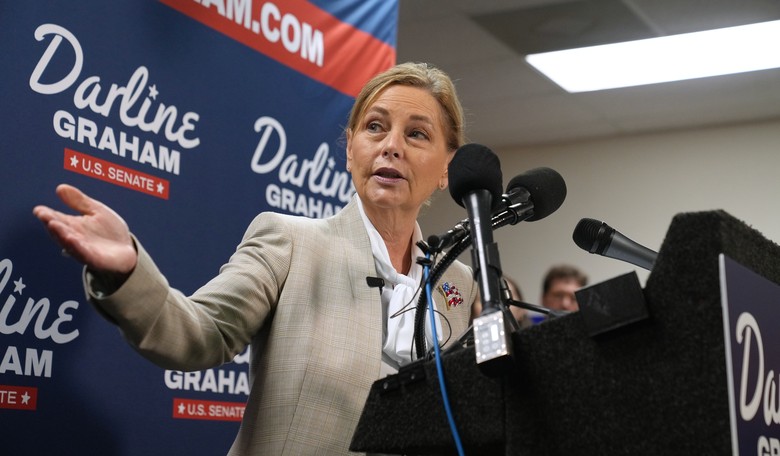
It’s that time. It’s judgment day in South Carolina. Will Sen. Darline Graham be able to serve a full term as U.S. senator, or will her appointment be temporary? We’ll find out as she faces off against Rep. Ralph Norman. Darline, the sister of the late Lindsey Graham, imploded during a debate with Norman. No doubt she had some decent zingers, but her admission that she wasn’t familiar with national security, as we’re dealing with Iran and the crisis in the Strait of Hormuz, was disqualifying. We’ll see if South Carolina voters feel the same. It could be a classic case of Ms. Lindsey Graham being suitable in the interim but disastrous in the long term. Still, this doesn't mean Norman has sewn up this election. Decision Desk has More (via Decision Desk):
Appointed Sen. Darline Graham wasn’t coasting to victory in South Carolina’s special Republican primary runoff for U.S. Senate, but she had plenty of reasons for optimism. Most critically, she had President Donald Trump’s endorsement, giving her the imprimatur of the most powerful person in the GOP. But she also had support from noted Republicans like fellow South Carolina Sen. Tim Scott, who also heads the National Republican Senatorial Committee. Graham enjoyed more outside spending support, boosted especially by groups that once helped her late brother, Sen. Lindsey Graham, whose seat she now holds and seeks to retain.
But last Wednesday, the Graham Gaffe struck the race. Facing her runoff opponent, Rep. Ralph Norman, in a debate, the appointed senator struggled to answer a national security question that would have been right in her brother’s wheelhouse. Asked about the importance of Taiwan to U.S. interests, Graham replied that “to be honest,” she was “not that informed on national security.”
Her bungled response potentially resets the race by giving Norman an opening to hammer Graham’s political inexperience. Norman has faced the same challenge as many other U.S. House members this cycle: Primary voters are not rewarding experience in Congress’s lower chamber, stopping many attempts to win higher office. Norman himself was an example of this earlier this year, when he lost South Carolina’s primary for governor. All told, 14 of 25 members of the U.S. House have lost primaries or primary runoffs for statewide office in 2026.
But Graham’s error could shift that anti-experience dynamic to boost Norman as he takes an unexpected second swing at statewide office this year. Outside of her last name, Graham remains somewhat unfamiliar to South Carolina voters, and now this goof could define her candidacy. The stakes are certainly high: The winner will be a clear favorite heading into the general election campaign against Democrat Annie Andrews.
Now, we have not seen any public polling testing Graham against Norman in the runoff, before or after her highly publicized mistake. So, that makes it hard to know just how much this development has affected the contours of the race. But the error has increased the uncertainty surrounding the outcome. Take the prediction markets: Following the first-round vote, both Kalshi and Polymarket gave Graham close to a 9 in 10 chance of winning. But following the debate, the markets began to view Graham somewhat more skeptically, with her chances having decreased to around 7 in 10.
[…]
Yet Norman could put together a majority coalition of his own in the runoff. He has the endorsement of Mark Sanford, a former governor and congressman from the coastal area who garnered 15% to finish fourth. Sanford’s support was concentrated mostly in the Lowcountry, which includes most of his old 1st Congressional District. Graham bested Sanford in those parts of the state, but finished second throughout it.
In his endorsement, Sanford cited the national debt hitting $40 trillion as what spurred him to come out publicly for Norman, though the timing certainly suggests the Graham Gaffe played into it. Sanford’s anti-establishment inclinations, especially on fiscal issues, line up with Norman’s small government ethos. Long a member of the hard-right Freedom Caucus, Norman has one of the most conservative records in Congress, according to VoteView.com’s measure of roll-call voting patterns.
That record as well as lingering conservative suspicions of Lindsey Graham could provide an opening for Norman in the northwest part of Upstate South Carolina. This area, centered on the Greenville-Spartanburg metro, is more evangelical Christian and socially conservative. Tellingly, it was home to the only two counties that Lindsey Graham lost to businessman Mark Lynch while winning renomination on June 9. (Lynch then finished fifth in the special primary with 6%.) Helpfully for Norman, his 5th District abuts this area to the east, which also makes him a natural geographical choice for voters who didn’t back him or Graham in the primary.
We also have an Oklahoma voter ID initiative, plus the Oklahoma Democrat Senate and Republican gubernatorial runoff tonight. The Georgia House runoff for the 13th District is also happening.
All polls close at 7 PM.