
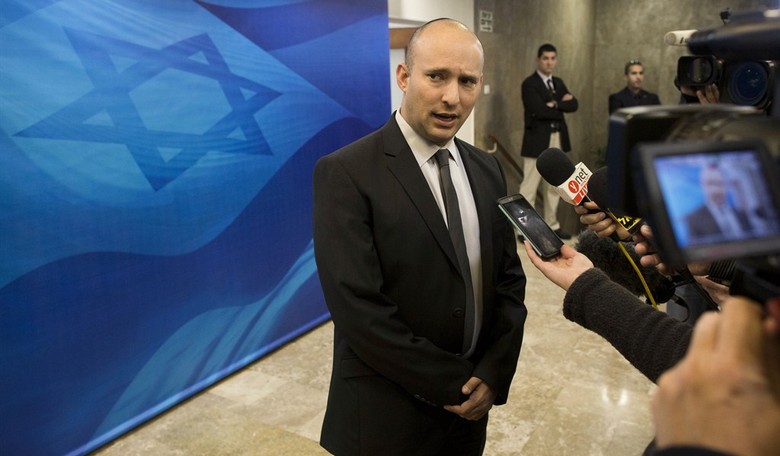
In June, I attended a campaign event in Jerusalem featuring former Prime Minister Naftali Bennett. As Israel’s October 27 national elections approach amid ongoing security challenges, political division, and economic pressures, the gathering highlighted the growing intensity of the race. Organized in English for the Anglo community, the well-structured evening included heavy security, and a looping TV interview with English subtitles showcasing Bennett speaking extemporaneously and engaging in thoughtful dialogue.
Bennett’s presentation was personable, interactive, and often spontaneous, especially during the lively Q&A session. Though he used a teleprompter to stay on message, his delivery felt authentic. As a native Hebrew speaker whose English carries the natural cadence of someone raised in a bilingual home, his fluency stood out, a notable asset in a campaign where competent English has itself become an issue. He diagnosed Israel’s core problems: internal fragmentation, economic burdens, security vulnerabilities, and educational disparities. While light on implementation details, his vision was clear, optimistic, and rooted in practical experience. It’s up to the voters to assess whether these issues are the primary issues, and if Bennett can deliver.
Bennett, who previously served as Minister of Education, Defense, and Israel’s 13th Prime Minister, is now leading the Beyachad party, an alliance with former Prime Minister and his former coalition partner Yair Lapid. This partnership recreates their earlier collaboration that achieved a surprise victory, while also qualifying them for state campaign funding. That’s no small thing where several or more other new parties are emerging and compete for votes but will not have state funding. Bennett’s remarks draw from his diverse background as a successful tech entrepreneur, IDF commander, and public servant to position himself as a pragmatic Zionist leader capable of delivering results.
He opened by sharing his personal family story. The son of American immigrants who arrived in Haifa shortly after the 1967 Six-Day War, Bennett described how his left-leaning, secular parents from San Francisco became deeply connected to Israel. Their decision to immigrate gave him the “best gift” of being born in Israel, serving in its army, building startups, raising a family, and eventually leading the nation. He used this narrative to underscore themes of unity, resilience, and potential.
Bennett framed the 2026 election as one of the most critical in Israel’s history, the third period of Jewish sovereignty in the Land of Israel. Referencing the First and Second Temple periods, which ended due to internal hatred and division, he warned: “This is it. We’re not going to have another chance.” He rejected defeatist attitudes (“There’s nothing we can do about world opinion, the draft, prices, or crime”) as fundamentally un-Zionist. “Zionism is about making the impossible possible,” he declared, calling on this generation to unite and repair the country after years of war and dysfunction.
The audience responded with the loudest applause to his firm stance on ultra-Orthodox draft exemptions, and the need for a formal constitution. Israel currently relies on a collection of Basic Laws that function in that role. Bennett promised decisive action from day one. At the first government meeting after inauguration, he would establish a state commission of inquiry into the catastrophic failures of October 7. “After such a colossal failure, the bereaved families and all the State of Israel deserve answers to ensure this will never happen again.”
He also pledged an eight-year term limit for prime ministers, citing biblical and historical examples like Gideon, George Washington, and Cincinnatus who voluntarily stepped away from power. “Am Yisrael – the People of Israel - is stronger than any one leader,” he stated, aiming to prevent personality cults and promote democratic renewal.
Ending the ultra-Orthodox draft exemption is a cornerstone of Bennett’s platform. He argued there is no historical Jewish precedent for large-scale Torah study replacing military duty or productive work. Abraham, Joshua, David, and great rabbis like Rashi all combined learning with engagement in the real world. Bennett proposed canceling benefits for draft evaders and redirecting billions of shekels to those who serve. Creative solutions include combined yeshiva-IDF programs. This would ease the unsustainable burden on many reservists struggling to build careers and families, and make national service equitable, encouraging massive new immigration.
Bennett called for dismantling Israel’s fragmented, tribal education system, where different communities operate parallel networks. His reform envisions one national public education framework with a mandatory 60 percent common core curriculum for every child: Hebrew, English, math, Civics, Democracy, Zionism, and Tanakh (Bible) with appropriate adaptations for Arab students. The remaining 40 percent would allow communities flexibility for deeper religious studies, arts, technology, or other electives. State funding would be tied to teaching this shared foundation. Drawing on his success as Education Minister, where he doubled participation in advanced level math, Bennett vowed that every child whether “in Dimona, Jerusalem, or Kiryat Shmona” would gain the skills needed for 21st-century success. “We can’t have a state within a state.”
Bennett noted high prices in Israel result from insufficient competition rather than geography or necessity. Citing past achievements, such as opening markets to reduce cheese prices by approximately 50 percent, and cutting murder rates by over 20 percent through focused law-and-order policies. He promised aggressive removal of thousands of non-tariff barriers, bureaucratic obstacles, and regulatory capture by special interests. He illustrated the problem with an arcane“soy drink” labeling rule that blocked imports to protect local monopolies. Future priorities include bold antitrust measures, and positioning Israel as a global leader in AI, targeting a top-three ranking worldwide as a strategic national asset. “The next global race is AI. We need to be at the forefront.”
Additional priorities include urgent rebuilding of the North (Galilee), where many displaced residents have not returned, ensuring independent Israeli arms and ammunition production, maintaining zero tolerance for terrorism, and firmly rejecting a Palestinian state. Bennett stressed assembling a “dream team” of proven CEOs and effective managers rather than career politicians. Ministers would be expected to actually work, a “novel concept” that defined his previous government. He acknowledged ideological differences with Lapid, but emphasized their shared commitment to fixing Israel and restoring its status as “a light unto the nations.”
Bennett closed on a hopeful note rooted in Jewish history and his family’s journey. He urged attendees to become advocates. “Four years from now, we will look back and say… back in 2026, we chose hope. Together, we wrote the next chapter of Israel.”
Whether Bennett and Beyachad prevail in October remains uncertain in Israel’s complex coalition-based system. Since June, they have slipped in the polls to a new party under the auspices of former IDF Chief of Staff Gadi Eisenkot. Implementation of any ambitious agenda and the coalition building itself will require negotiation and compromise, and a broad-based coalition that can agree on the main points to get there. Yet his ideas, even those that seem less realistic, are practical, results-focused, and grounded in both tradition and modernity. They offer a substantive contribution to the national conversation at a pivotal time.
This is not an endorsement of Bennett, Lapid or Beyachad. I went into the evening undecided, and left even more so.
Bennett’s full presentation is available online and well worth watching. A dialogue about his policies and polls will be held with undecided Israeli voters on August 12 at 1;00PM Eastern time (US). Registration is free.