
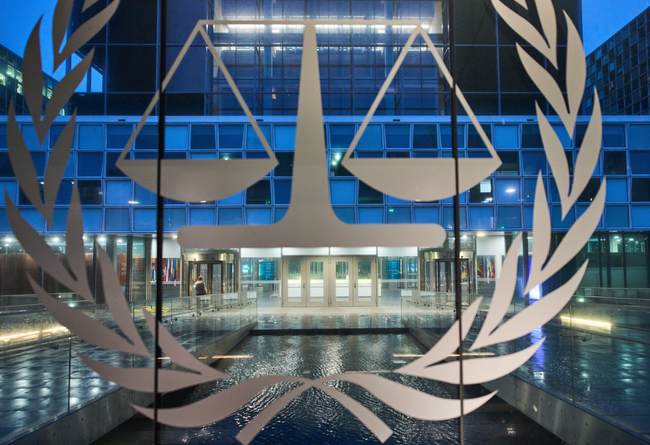
Having spent 30 years enforcing the law in Germany, Iraq, South Korea, and a dozen other places, one of the most important lessons I learned is that bureaucracies place justice behind the fulfillment of self-serving ambitions. As former Senior Antiterrorism/Force Protection Officer for the Coalition Forces in Iraq, I know what accountability looks like when it is real, and when it is theater. The International Criminal Court (ICC) is theater — and dangerous theater at that.
Let me be plain about the legal foundation. The United States withdrew its signature from the Rome Statute, the founding treaty of the ICC, in May 2002. Israel had signed the Statute in 2000 but notified the Secretary General of the UN that it would not become a party to the treaty in 2002. Thus, neither nation is subject to the Court's authority. Under settled international law, a treaty binds its parties — not states that decline to join. When the ICC issues arrest warrants for American military personnel or Israeli heads of government, it is not enforcing international law. It is stretching its jurisdiction over nations that explicitly withheld consent.
The Court's defenders argue that if crimes allegedly occur on the territory of a member state, the court may pursue any national involved, regardless of their country's membership. Palestine acceded to the Rome Statute in 2015; Afghanistan was already a party. Under this theory, a third party's unilateral decision to join a treaty can expose American soldiers and Israeli commanders to a court neither nation has agreed to face. The U.S. and Israel don’t even recognize Palestine as a state. The ICC is overreaching
Consider Luis Moreno Ocampo, the court's founding prosecutor, who served from 2003 to 2012. Subsequently, reports surfaced showing that while drawing a plump public salary from the court's 124 member states, he controlled undisclosed shell companies in Panama, the British Virgin Islands, and Belize. During that time, he brought only one case through to trial and conviction. Meanwhile, his record was marred by a high-profile bungled investigation into post-electoral violence in Kenya, and his heavy focus on African states to the exclusion of others drew repeated criticism for what appeared to be a one-sided docket. The irritation among African states became so pronounced that the African Union endorsed a strategy to withdraw from the ICC in 2017.
This flawed record alone should have ended Ocampo’s credibility. It did not.
In August 2023, he published an "expert opinion" concluding Azerbaijan was committing genocide against Armenians in Nagorno-Karabakh and testified to that effect before the U.S. House Tom Lantos Human Rights Commission. International law scholars are blunt: genocide requires proof of specific intent to destroy a group — a standard his opinion did not establish.
Then came April 2026. Video recordings were made public that show Ocampo and his son discussing what appears to be a covert influence campaign running simultaneously in Washington and Brussels, actively shaping European Parliament policy on the South Caucasus, pressuring EU Commission President von der Leyen, and attempting to overturn the EU's energy cooperation agreement with Azerbaijan through litigation. The operation, per these recordings, was financed by Armenian oligarchs.
What the recordings describe does not look like a retired lawyer doing advocacy. It appears as a covert foreign lobbying operation, financed by one side of an ethnic conflict, and run by the man who spent nine years building the ICC's institutional relationships and political access — then monetized all of it. The pedigree that gave him congressional testimony slots and European Parliament entrée was built on the public's dime.
The court's structural problems run deeper than one stray prosecutor. After exercising prosecutorial power for two years while under investigation, ICC Prosecutor Karim Khan was removed from office over allegations of sexual misconduct. Of the world's 20 largest economies, fewer than half are parties to the Rome Statute. The United States, China, Russia, India, Israel, and Turkey are out. The court cannot deal with China's treatment of the Uyghurs or Russia's conduct in Ukraine and Syria, where hundreds of thousands of civilians have been killed or forced to flee.
The ICC has produced fewer than 15 convictions in two decades, several overturned on appeal. Its first major conviction was nearly voided twice by Ocampo’s mishandling of evidence. As noted earlier, the Kenya prosecutions collapsed entirely. An ICC arrest warrant was issued for Vladimir Putin in 2023. Putin has since traveled to the ICC member state of Mongolia, to Alaska, and hosted foreign leaders in Moscow.
The difference between accountability and impunity is not a press release but a consequence. The ICC produces press releases. It targets leaders of nations that cannot protect themselves and issues warrants it cannot enforce against those that can.
The Trump Administration is right to resist this court's jurisdictional reach over American personnel and Israeli officials. What this institution has demonstrated, from its founding prosecutor to its current crisis, is that the guardians needed guarding — and nobody was watching. Secretary of State Marco Rubio is right: the ICC needs to be shut down. A travesty of justice is not justice.