
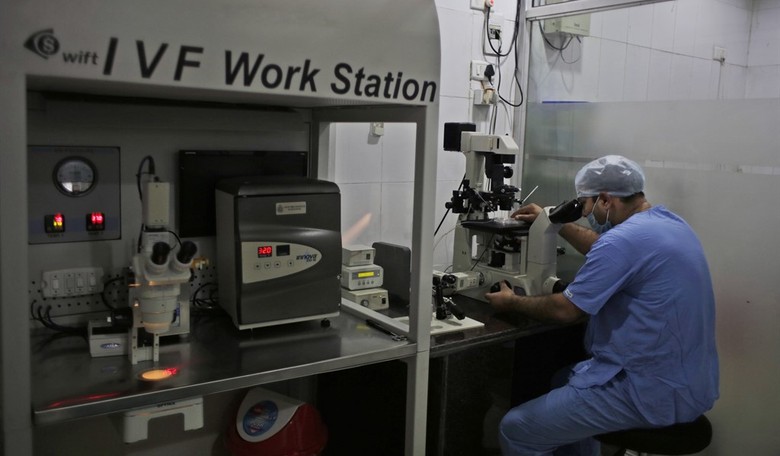
How private equity consolidation of fertility networks is eroding root-level care and diagnostics for women as young as 13.
Grace Stark was just 23 years old when she miscarried her first child. Sitting in the San Diego Naval Hospital’s OB Department, she watched as giddy parents-to-be headed into their ultrasounds and heartbeat monitoring. Grace was headed into a postmortem. Blinking back tears, she sat through the appointment with the doctor, who told her that she had “primary infertility.” “No s**t,” she thought. She had been struggling for a year and a half with infertility, but her doctor did not know or bother to ask about it. Instead, he did what almost every single OB-GYN would do: he offered her IVF.
After getting married to her military husband, Grace began practicing the natural family planning method to conceive, but had no success over six months. She knew her cycle and her body, and after six months of trying with no success, she felt something was wrong. She sought a fertility workup from her military doctor, but was told that protocol requires at least 12 months of trying before she could be seen. “I wish I would’ve lied, I knew better,” she said. Bags packed, she and her husband moved to Guam for his stationing with nothing more than a prayer. After a few months, her periods grew heavier and more painful, with migraines that confined her to the couch.
She had dealt with painful menstrual cycles growing up, but because of her Catholic faith, she did not want to start birth control. “My mom and I weren't aware that there was anything that could be done, that the only thing we would be offered was birth control,” she said. She recalled that same helplessness, assuming a call to her doctor would end with either an IVF referral or another push for birth control. She was wrong.
Grace called the Guam hospital, which told her that her military-assigned doctor was off-island and asked if she wouldn’t mind switching to a man. With dwindling hope, Grace sighed and accepted the switch. Her newly assigned primary care physician, Dr. Brian Burke, began the appointment with detailed questions about Grace’s cycle, asking her what no doctor had ever thought to ask. Fatefully, Dr. Burke had been trained in Natural Procreative Technology (NaPro), a form of Restorative Reproductive Medicine (RRM). NaPro technology seeks to determine the root cause of infertility by intricately tracking women’s menstrual cycles and implementing various routine changes. Immediately, the two made a plan to uncover why Grace was struggling to conceive. “I burst into tears,” Grace said.
With many tests, hormone supplementation, and some diet changes for both her and her husband, Grace managed to conceive. The couple flew to California to visit family, making many hospital visits because of repeated bleeding complications. During one visit, the nurse was unable to detect the baby’s heartbeat. Grace miscarried her baby in the hospital a short time later.
A few days later, she found herself surrounded by the joy of new parents while she awaited the appointment to ensure her deceased baby’s placenta had passed. Moments after that appointment, the doctor she had just met suggested IVF.
“It was so awful after that experience to basically be given a sales pitch for IVF from someone who had absolutely no idea about any of my medical history, or about the values that my husband and I held, and barely even acknowledge that I'd had a miscarriage,” she said. “He just saw somebody who would be a good IVF success story for them, like a guinea pig.”
Grace went back to NaPro methods and is now a mother to four healthy children, with no problems conceiving. Still, that feeling of being treated like a client, like she was someone to be convinced, never left her memory. She said that IVF, like birth control, is treated like a one-size-fits-all cure. Referring to birth control, Grace said, “It’s like the age-old adage. When all you have is a hammer, every problem looks like a nail, and IVF is a continuation of that.”
According to the American Society For Reproductive Medicine’s (ASRM) own practice guidelines, which Townhall was directed to after the American College of Obstetrics and Gynecology (ACOG) declined to comment, diagnostic testing should begin immediately for patients with “known or suspected” conditions linked to infertility, including irregular menstrual cycles or suspected endometriosis. Grace's later symptoms, heavier and more painful periods, would seem to qualify, yet no such evaluation was offered until she met with a NaPro doctor.
Grace’s experience is nothing new. Between 2020 and 2022, the number of IVF and other Assisted Reproductive Technology (ART) cycles started in the U.S. jumped 33.4 percent, with annual IVF births surpassing 100,000 in 2024 for the first time, according to the Society for Assisted Reproductive Technology.
Coinciding with that rise, as one University of Michigan study found, is the substantial increase in private equity (PE) ownership of U.S. fertility clinics over the past decade. In 2013, just 3.7 percent of U.S. fertility clinics were affiliated with PE firms. By the end of 2023, that figure had risen to 32.1 percent — 163 of 507 clinics that reported 2022 data to the CDC were private equity-affiliated. Those 163 clinics alone performed an estimated 54 percent of all U.S. IVF cycles in 2023, despite making up less than a third of all clinics.
Zooming in reveals that U.S. Fertility — the largest network of fertility clinics in the nation — was bought out almost entirely by PE firms in 2025. Amulet Capital and L Catterton own a combined 85 percent stake in the network, which was founded in May 2020 by Amulet Capital and Shady Grove Fertility, the largest independent fertility practice in the United States.
Outside private equity's model is the RRM approach that its practitioners say works better and faster. Dr. Teresa Hilgers, an OB-GYN who practices NaPro technology at the St. Paul VI Institute, described root-cause-oriented care. “With NaPro technology, we have couples chart their cycles in a standardized, objective fashion, which gives us all this information called biomarkers, and that really helps guide our ability to evaluate and treat the menstrual cycle,” she said. She explained that NaPro diagnostics like the Creighton Model found “several major areas” that contribute to infertility, such as ovulation abnormalities, low male sperm count, and conditions like Polyendocrine Metabolic Ovarian Syndrome (PMOS), formerly PCOS. Hilgers said endometriosis alone describes “72 to 77 percent of infertile couples.” NaPro diagnostics also cut the traditional infertility protocol in half, using just six cycles to start treatments.
“We want to do a really good evaluation first, so we get the proper diagnoses, and then we work at correcting them to the best of our ability,” Hilgers said. “That then improves the couple's fertility, the woman's menstrual cycle, and gives them their best opportunity to achieve a pregnancy.” Hilgers also mentioned preterm labor comparisons, saying, “With NaPro technology, we have a lower preterm labor and delivery rate than IVF. With IVF, it's about 15 percent give or take, and with NaPro, it's 8 percent.”
ASRM referred Townhall to its reviews on RRM methods, which claim to have found “no high-quality evidence demonstrating that RRM is as effective as ART,” and that commonly promoted RRM interventions have limited evidence to support their effectiveness.
For most women, the causes of their infertility manifest through irregular and/or painful menstrual cycles as early as age 13. Rather than being diagnosed and treated, however, most are immediately prescribed birth control to mask symptoms. Years later, their infertility struggles often remain undiagnosed and are treated with the same band-aid-style care. This time, it’s IVF.
Haley Yeager, a 26-year-old FertilityCare practitioner, described her struggle with irregular periods when she was 16 years old, which prompted a doctor’s consultation. “I went to the doctor, and no questions asked, it was just, ‘What kind of birth control do you want?’” she recounted. “There was no blood work, no ultrasound, no form of diagnostics. It was just ‘here's the pill.’”
Like most other teenagers, Haley didn’t know any better and took the pill. She experienced depression and moodiness instantly, trying different variations before ultimately stopping after just two months. Eventually, Haley sought help through a NaPro technology clinic. Cycle charting and ultrasounds helped doctors diagnose her with PMOS, one of the leading causes of infertility. Though common and treatable, PMOS is significantly underdiagnosed, with approximately 70 percent of cases never being diagnosed.
Haley was “thankful” for her extreme symptoms, which compelled her to quickly get off the pill. “Had I stayed on the birth control pill like most women do, I would not have the kids that I have today…We would have had a story of infertility, which would have just taken us down like the IVF route. That's exactly what the trajectory is,” she said.
That trajectory is clinically entrenched, Hilgers explained. Speaking about ACOG’s frequent encouragement of birth control prescriptions, she said, “There's all these benefits of birth control that are promoted throughout our training, and it's typically one of the first medications you're going to reach for for almost every gynecologic condition.” She pointed to a practice bulletin titled the “Noncontraceptive Uses of Contraceptives,” which discusses all of the non-hormonal benefits to birth control, including the decreases in pain and cancer risks, and the improvements in acne and anemia associated with abnormal bleeding.
Hilgers said that the rapid prescription of birth control essentially “kicks the can down the road” for diagnosing problems that explain infertility. “A major cause of infertility is endometriosis, and so a lot of times these women don't get the diagnosis until they stop birth control to have a baby, and now they can't have a baby,” she explained. “The best time to treat the disease is when women are adolescents to get on top of it when they first present with these issues.”
For the many women who are not diagnosed in a timely manner, a diagnosis of “unexplained infertility” is likely in their future — but Dr. Hilgers doesn’t buy it. “Unexplained infertility normally means they were never evaluated completely,” she said. “There’s almost always a reason why the couple is infertile. So ‘unexplained’ should be a very, very, very, very small percentage of patients.”
Dr. Hilgers said her patients described feeling like part of an “assembly line,” and many were “turned off” by the diagnosis and subsequent IVF referral.
She talked about that pressure too, saying, “I think there's a little bit of preying going on, whether it's intentional or unintentional. IVF is a huge money-making industry, and these couples will do almost anything to have a baby. It’s the perfect patient pool for IVF.”
Haley Yeager agreed. “The cynical part of me would say that restorative medicine doesn't make as much money as birth control,” she said. “IVF is also a huge money-making business — making women's bodies healthier and restoring their health is not a money maker.”
Private equity centers on growing the value of companies over time before selling them for profit. In other words, it hinges on money-making.
Emma Waters, a senior policy analyst in the Center for Technology and the Human Person at the Heritage Foundation, warned of the consequences of PE buyouts. “If a private equity model is an investment in a high-turnaround, lucrative business with the expectation that it will result in a lot of money in a short amount of time, and even to increase their resale value, that in and of itself, just as a model for how we're treating infertility, strikes me as incredibly problematic,” she said.
She noted that “The business model of IVF itself (not the individual endocrinologists) has become so corrupt that it's hard to reconcile with a true patient-first model for treating infertility.”
“For example, private equity firms are far more likely to push for preimplantation genetic testing of human embryos, as well as other services related to different hatching approaches,” she said. “Maybe those tests aren't more ethically fraught than just the course of IVF itself, but they certainly tell parents that if they pay more, they might have a better chance of having a baby, when success rates suggest that that's just not the case.”
Amulet Capital — the private equity firm that co-owns U.S. Fertility — outlines this strategy through its own portfolio. The firm’s investment thesis lists a “significant upside from expanding high-value ancillary services,” and describes developing “comprehensive fertility-focused ancillary offerings,” like “ASC, lab, pharmacy, genetics, nutrition, cryostorage.” Studies are in fact showing, however, that tests like preimplantation genetic tests (PGT-A) do not improve overall pregnancy outcomes across the study population.
Waters also pointed to a preprint study which found that deeper diagnostic workups that are supposed to occur before IVF rarely do. Published on July 13 by an actuarial firm, the study reviewed health insurance claims for roughly 5 million patients treated for infertility between 2021 and 2024. The study, currently undergoing peer review, evaluated adherence to the American Society for Reproductive Medicine (ASRM) and American Urological Association (AUA) guidelines for patients who subsequently underwent IVF.
Looking at bill services for patients who received infertility treatment, the study found a large gap in diagnostic workups that fertility clinics were supposed to offer and those that they were actually providing. About 70-85 percent of couples with infertility had begun IVF, but between 13 percent and 78 percent had not received the basic diagnostic workup for the underlying conditions prior to starting IVF. Waters explained the number discrepancy, saying that workups for male infertility were much lower than those for women, who were more likely to receive higher rates of hormonal tests.
Waters connected the study to the current discourse around RRM in medicine. “There's been about a year and a half of discourse where ASRM, ACOG, and other major fertility groups will simultaneously claim that RRM is mere ideology; it's not real medicine, and also that they're already providing this root cause care,” she said. “The reality is that neither of those are true because restorative reproductive medicine’s approaches have been around since the 1980s. What's new is that there's now a political movement representing them.”
ASRM's own 2026 evidence review, which Townhall was referred to, found “no high-quality evidence” that RRM matches IVF's effectiveness — though it carved out exceptions for certain endocrine and ovulation disorders, the very conditions NaPro practitioners like Hilgers say they specialize in treating.
“They [private equity] essentially have a monopoly,” Waters said. “The more popular restorative reproductive medicine becomes, that certainly threatens the private equity model of having access to a concentrated set of patients.”
Waters explained that pursuing fertility treatments at an IVF clinic is the “assumed route,” and leaves couples with just one option. “In part, that’s what has interested private equity firms' investment so much,” she said.
The current IVF model, bought out by PE, rewards market deliverables, not medical care. Grace’s miscarriage was seen as a potential success metric, and Haley’s birth control prescription was just a band-aid masquerading as a cure. A single IVF cycle costs anywhere from $15,000 to $30,000; RRM prices range from $2,000 to $16,000 depending on the service. RRM's live-birth rates have outperformed IVF's per-cycle rates in several studies, according to Waters' own published analysis. RRM success also restores a couple's natural fertility, rendering further cycles unnecessary. But money talks.
Townhall reached out repeatedly to U.S. Fertility and Amulet Capital for comment on this story, but neither responded by the time of publication. ACOG declined to comment but referred Townhall to ASRM, which responded with practice guidelines and reviews that were referenced throughout in lieu of a statement.