
Even with the unpredictability of evil actors in matters of war, a normalcy bias that developed after World War II has enveloped the minds of many policymakers involved with U.S. war-fighting strategy. American approaches to war for the last 70 years have been characterized by a normalcy bias that war conduct should be guided by the goal of reaching negotiated compromise outcomes rather than achieving victory and total defeat of the enemy.
Douglas MacArthur was relieved of duty as Commanding General of the U.S. Army Forces-Far East on April 11, 1951, almost a year into the Korean War. A week later, he gave his farewell address to a joint session of the U.S. Congress, a speech that was coined as the “No Substitute for Victory in War” speech. MacArthur’s full quote on the essential importance of victory in that speech was, "War's very object is victory, not prolonged indecision. In war, there is no substitute for victory."
The current war with Iran that started on February 28, 2026, has not been conducted by the MacArthur maxim. Rather, similar to previous conflicts, it has been carried out through cycles of intense strikes, ceasefires and lengthy “peace” negotiations, and truce breakdowns followed by retaliatory strikes, which have led to the next round of the same — almost a predictable on-again-off-again pattern, with Iran rearming during every ceasefire.
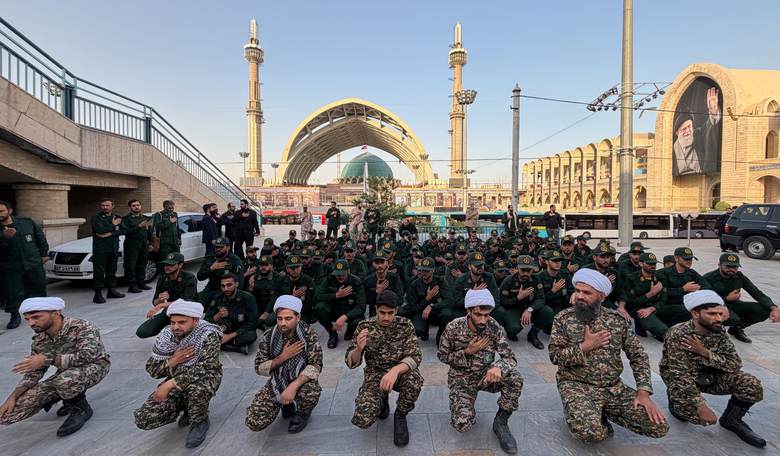
Every time Trump and his military brass think their increased strikes and bomb tonnage have finally achieved the level of pain that will bring about a lasting truce and peace deal on acceptable terms with the Iranian mullah leadership, the IRGC has turned around with a variety of military strikes, apparently to reassert that they can neither be defeated nor dislodged from their dominant position in controlling the Straits of Hormuz.
The Iranian mullah regime’s bad faith is rooted in their unique Shia Muslim belief system in which compromise with the “infidel” is defeat, and defeat is simply not an option. We know this from the fact that the IRGC runs deep ideological training programs built on sacrifice being glorified around martyrdom. Analysts note the IRGC recruits and retains only those totally committed to this uncompromising suicidal posture.
During the Iran-Iraq War between 1980 and 1988, hundreds of thousands of Iranians, including children as young as 12, volunteered for human wave attacks and walked over minefields believing martyrdom was God's greatest reward. Training materials condition recruits to view martyrdom not as an unfortunate consequence of war but as the highest virtue. In fact, an entire IRGC state-affiliated apparatus exists specifically to promote and publicize martyrdom as a virtue. The bottom line is that even if mullah-IRGC leadership concludes it can't win militarily, it is likely to pursue "victory" as the symbolic legacy of having fought to the end.
The Trump administration needs to suspend the last vestiges of a normalcy bias that elevates negotiation over strategic success in winning wars. And second, we must always remember that the psychological dimension of war is just as important as the kinetic dimension. Iran has many allies with tentacles into the U.S. media, elite think tanks, and the Democrat Party that push the idea that the United States and Israel cannot defeat Iran. The mullahs are playing us with delays, knowing that the American people will lose patience and likely turn against the war.
For those who think the Islamic regime in Iran is unbeatable because of its radical theocratic death-cult, it is worth returning to General Douglass MacArthur, who presided over the total defeat of Japan, signing the surrender agreement on behalf of all Allied powers on the deck of the USS Missouri on September 2, 1945.
Iran has much in common with pre-World War II Japan in terms of its absolutist religious culture being melded into its political culture. The primary commonality of the former State Shintoism in Japan and today’s Shia Islamist regime in Iran is that both believe their god does not permit defeat and that dying in battle for the triumph of the state was a sure path to sacred honor and divine appointment in the afterlife.
At the time of World War II, Japanese Emperor Hirohito was officially regarded as a direct descendant of the sun goddess Amaterasu, making him divine and infallible. This wasn't a fringe belief — it was taught in schools, embedded in law, and reinforced through ritual throughout Japanese society. Loyalty to the emperor was inseparable from religious devotion. The Meiji government had reorganized Shinto shrines into a state-run hierarchy, different from ordinary "religious" Shintoism. This development prompted many Japanese citizens comfortable with their traditional Shinto beliefs to embrace State Shintoism, which included dying in battle for the emperor, which was also framed as a path to a kind of sacred honor. And that fed into ideologies like the kamikaze corps, very similar to the Shia IRGC death cult and extremist factions of Salafi-jihadism in Sunni Islam, such as Al-Qaeda.
There is a significant difference between the State Shintoism in Japan of earlier times and the radical Shia ruling class in Iran today. In Japan, support for Emperor Hirohito and State Shintoism was a significant majority. But the opposite is the case in Iran, where only 10 percent of the population supports the Mullah-IRGC regime, while more than 80 percent of the Iranian people strongly oppose it.
The end of the conflict in Iran can come soon. It requires three successful initiatives to be implemented by the United States and some of its well-armed Middle East allies who will hopefully join in bringing a quick end to Iran’s radical Mullah regime: First, all overland transportation routes into Iran for military resupply need to be neutralized and made impassable. Second, the U.S. and its allies need to seize or destroy every Iranian port facility that has the capacity to export oil. Third, the Iranian opposition needs to be armed in sufficient numbers to finish the job of eliminating the last remnants of IRGC operatives in Iran once the U.S. completes the first two initiatives.
The United States has come too far in five months to fail to liberate the Iranian people from a regime that has slaughtered some 40,000+ of its own citizens in the last six months. Iran under the ayatollahs and IRGC has been the number one source of terrorism globally, responsible for killing or maiming 30,000+ Americans. As of mid-2026, roughly 40 countries have designated the IRGC (or its Quds Force specifically) as an international terrorist organization.
Trump is the first U.S. president in 47 years to take decisive military actions against the terrorist regime in Iran. There is simply no greater accomplishment to bring peace and stability to the Middle East than the removal of this radical Shia Iranian Mullah regime. It is time to stop negotiating with terrorists and get the job done.
Scott S Powell is senior fellow at the Discovery Institute. His book, "Rediscovering America" — a previous #1 new release in history at Amazon for eight straight weeks — provides unique insights for this year’s Quarter Millennium 250th anniversary of America’s founding. Reach him at scottp@discovery.org.