
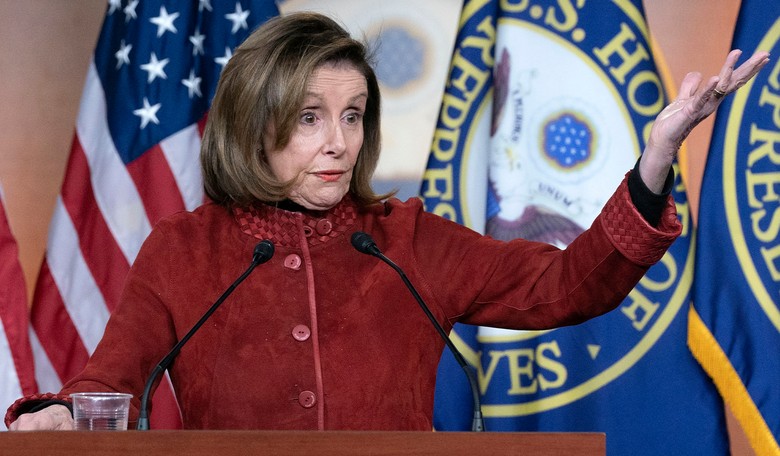
Former House Speaker Nancy Pelosi reveled in the indictment of President Donald Trump Thursday night and revealed a lot about the Democratic Party's thinking towards persecution from the government.
In a tweet about the indictment, which was filed in unprecedented fashion by Manhattan District Attorney Alvin Bragg, Pelosi declared trial is a place for an individual to "prove their innocence."
The Grand Jury has acted upon the facts and the law.
— Nancy Pelosi (@SpeakerPelosi) March 31, 2023
No one is above the law, and everyone has the right to a trial to prove innocence.
Hopefully, the former President will peacefully respect the system, which grants him that right.
The legal standard in the United States of America has always been innocent until proven guilty.
3.02 Presumption of Innocence; Proof Beyond a Reasonable Doubt
It is a cardinal principle of our system of justice that every person accused of a crime is presumed to be innocent unless and until his or her guilt is established beyond a reasonable doubt. The presumption is not a mere formality. It is a matter of the most important substance.
The presumption of innocence alone may be sufficient to raise a reasonable doubt and to require the acquittal of a defendant. The defendant before you, [__________], has the benefit of that presumption throughout the trial, and you are not to convict [him/her] of a particular charge unless you are persuaded of [his/her] guilt of that charge beyond a reasonable doubt.
The presumption of innocence until proven guilty means that the burden of proof is always on the government to satisfy you that [defendant] is guilty of the crime with which [he/she] is charged beyond a reasonable doubt. The law does not require that the government prove guilt beyond all possible doubt; proof beyond a reasonable doubt is sufficient to convict. This burden never shifts to [defendant]. It is always the government's burden to prove each of the elements of the crime[s] charged beyond a reasonable doubt by the evidence and the reasonable inferences to be drawn from that evidence. [Defendant] has the right to rely upon the failure or inability of the government to establish beyond a reasonable doubt any essential element of a crime charged against [him/her].
If, after fair and impartial consideration of all the evidence, you have a reasonable doubt as to [defendant]'s guilt of a particular crime, it is your duty to acquit [him/her] of that crime. On the other hand, if, after fair and impartial consideration of all the evidence, you are satisfied beyond a reasonable doubt of [defendant]'s guilt of a particular crime, you should vote to convict [him/her].
Democrats, especially with continued targeting of Trump and his family, have worked hard to change that standard for their political enemies.
No Nancy, we have the right to be presumed innocent until the prosecution PROVES guilt beyond a reasonable doubt. That’s how our system is supposed to work. I know you’re building a system where we’re presumed guilty until innocent but that’s un-American!
— Robby Starbuck (@robbystarbuck) March 31, 2023
Are you truly this ignorant? This imbecilic? This misguided? This fascistic? A "trial to prove innocence"? Are you familiar with the concept of presumption of innocence as the DEFAULT a priori position? You are a disgrace. [I'll retweet.]
— Gad Saad (@GadSaad) March 31, 2023
In America, you are PRESUMED INNOCENT — not guilty.
— Chad Gilmartin (@ChadGilmartinCA) March 31, 2023
"Prove Innocence"
— Bill Speros (@billsperos) March 31, 2023
Maybe in Vichy France, but not according to the US Constitution
All defendants have the presumption of innocence. It is the job of the prosecution to prove guilt beyond a reasonable doubt. Very basic stuff, and true even for your political opponents. https://t.co/yOB44aAKm3
— Jerry Dunleavy (@JerryDunleavy) March 31, 2023