
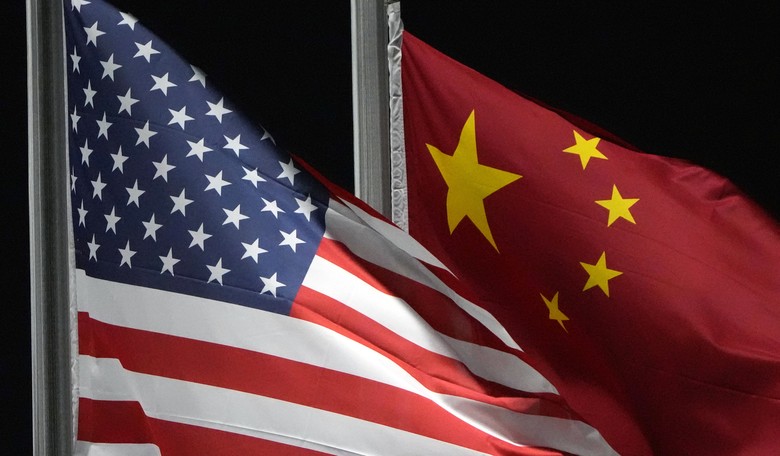
China’s artificial intelligence (AI) developers are purchasing American professional expertise to sharpen their systems, a new report warns, undermining Washington’s efforts to preserve the United States’ dominance in the AI arms race.
The report, titled “American AI Advantage Is for Sale,” notes American companies are selling to buyers that include Chinese technology companies identified by the Pentagon as military-linked. The report calls for increased scrutiny of the sale of training data as well as federal contractors’ relationships with Chinese buyers.
Six of China’s largest AI laboratories have spent roughly a collective $500 million annually purchasing data from American companies, according to a Forbes report cited by Consumer Action for a Strong Economy (CASE).
CASE, a non-profit organization that advocates for “free-markets, fiscal responsibility and reasonable consumer protections,” argues that Washington has focused too much on restricting China’s access to advanced chips, giving the Chinese the opportunity to purchase American training material designed to make AI more powerful.
“For decades, Washington worried about China stealing American know-how,” the report reads. “Now parts of that know-how can simply be bought in the open from U.S. data labs.”
That oversight has allowed the Chinese to create improved systems that are competitive with American models, according to the report.
Now, CASE is calling for targeted restrictions on those sales as well as additional scrutiny of federal contractors’ relationships with Chinese buyers.
Surge AI, a company valued at roughly $25 billion, has partnered with the U.S. military on several occasions. It has partnered with the Air Force to create an AI system designed to search and summarize intelligence reports, while it also worked with the Army on AI-assisted data labeling, according to federal records. Forbes also reported that Surge supplies data to Tencent, a CCP-linked technology company the Pentagon labeled a “Chinese military company” in 2025.
Tencent disputes this designation, but CASE scrutinizes its proximity to American training data capabilities, regardless of whether or not classified information was made available to the group.
As developers look to increase the capabilities of new AI systems, researchers are opting to depend on human intelligence rather than books, websites, and other public information as most AI models up to this point have. Now developers want to train AI with data collected directly from humans for the purpose of AI systems.
While the new programming also involves information collected from websites, it now depends on training material created by recruited professionals. American vendors hire various professionals to create difficult problems, explain their solutions, and establish standards for evaluating an AI system’s answers.
From there, companies package that work into training databases that can be sold to multiple developers, allowing Chinese buyers to benefit from the same American data industry as many of their U.S. competitors.
“In practical terms, this begins to resemble an apprenticeship conducted at machine scale,” the report reads.
CASE argues that selling those products to Chinese developers creates a commercial channel for transferring valuable professional knowledge that took American industries decades to build.
“What once had to be stolen can increasingly be purchased,” the report reads.
The financial incentives for American vendors are substantial and are potentially a key reason why U.S. companies opt into these kinds of transactions.
According to the Forbes investigation cited in the report, Chinese AI labs account for at least $50 million in recurring revenue at AfterQuery. Chinese customers made up roughly 2 percent of Mercor’s second-quarter revenue as the company reached a $2 billion annualized revenue rate.
The report cites the July 2026 launch of Kimi K3, an AI model produced by China’s Moonshot AI, as evidence of the competition facing American developers. The Chinese model became a serious competitor to top U.S. systems, making a response from Washington pertinent, CASE argues.
“Its performance sent a jolt through Silicon Valley and Washington and reinforced an uncomfortable reality: China’s AI industry is closing the gap faster than many expected,” the report says.
CASE says policymakers should examine the American intelligence aiding Chinese groups in their development of new AI systems, and calls for restrictions on computing hardware.
The group is urging Congress and the administration to reconsider targeted restrictions on advanced, proprietary AI-training products sold to Chinese developers, particularly those connected to the Chinese Communist Party, military, or other entities identified as national security concerns.
It also calls for federal agencies to review contractors serving those buyers and cautions them about those relationships.
“At minimum, federal contractors performing sensitive AI work should face disclosure and additional scrutiny when they are also helping strategically important Chinese companies improve their AI systems,” the report reads.
CASE says those restrictions should outline distinctions between commercial products created to improve advanced models from public research, ordinary business information, and open academic datasets.
The group also argues that efforts to preserve American AI leadership must account for the expertise used to train competing systems, as well as the chips powering them.
“America should not spend billions trying to preserve its AI advantage while ignoring an industry that is packaging some of the country’s most valuable professional expertise into training material that can help Chinese models close the gap,” the report says.