
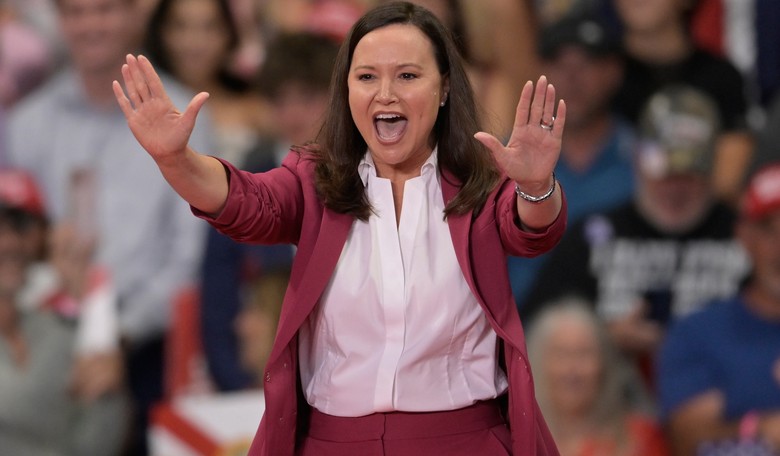
On a night with little good news for Republicans, last week’s election results in Florida were among the few bright spots. Republicans kept the governorship and all three Cabinet offices, while Sen. Ashley Moody defeated Democrat challenger Angie Nixon to keep her Senate seat.
Moody beat Nixon 50.9 percent to 48 percent in a race that was called at 8:33 PM ET, just 33 minutes after the final polls in Florida closed.
But Florida’s results can’t just be a bright spot on a dark night. As the GOP sorts through what went wrong elsewhere this cycle, Moody’s victory needs to be something the party studies and replicates heading into 2028.
Moody was certainly one of the GOP’s strongest candidates this cycle, but she’s been a force for many years, having earned more total votes than anyone on the state’s ballot for three consecutive cycles.
In 2018, she beat her Democrat opponent by six points as Ron DeSantis won by less than half a point in his race for governor. In 2022, Moody received roughly 37,000 more votes than DeSantis did, even as his landslide victory made him one of the hottest names in Republican politics.
Florida’s Republican voting history helped make Moody’s victory possible. But if last week proved anything, it’s that even the most red of states can turn blue in an instant.
“I fought tooth and nail this election to make sure Floridians know that what we have here is special, and it can be dismantled in one cycle,” Moody told Townhall.
Republicans lost Senate seats in Ohio and South Carolina, where Republican Senate candidates, like Moody, were appointed senators running to finish a term in red-leaning states. Yet both fell short, with Jon Husted and Darline Graham failing to reach even 47 percent of the vote.
Those losses also bring into question the issue of candidate quality, an issue Republicans have been debating since Tuesday.
Along with a record that showed her support for voters and the issues they cared about most, Moody’s charisma and poise helped her stand out in an otherwise lackluster field for Republicans this cycle.
Democrats recruited candidates with backgrounds or personas that reached beyond politics, including pastors in Texas’ James Talarico and Kansas’ Adam Hamilton, and pediatrician Annie Andrews in South Carolina. Republicans weren’t as effective in candidate likeability this cycle, although Moody was an exception.
Already a familiar face to many Floridians, Moody had entered the race with an identity beyond her Senate appointment. She had been a prosecutor, a judge, and Florida’s attorney general. Floridians had seen her name on the ballot already, and she’d delivered for them.
Throughout her campaign this cycle, Moody tackled top issues voters cared about. In an October poll, 40 percent of likely Florida voters listed inflation and cost of living as the top voting issue. Moody made this an integral part of her campaign, running on her vote for the One Big Beautiful Bill Act. She used this to prove to voters that across her time in office, she’s delivered for them in bringing tax cuts to tips and overtime pay, and other cuts for senior citizens.
“Talking to folks on the ground and meeting them where they were was vital, and I heard many people from all political backgrounds present a consistent message — they want a government that is accountable and a government that protects their pursuit of the American Dream,” Moody told Townhall. “I put that front and center in my campaign, and Floridians backed me for it.”
The GOP has a lot of work to do before 2028. Studying its many defeats will inevitably be a part of that. But when a candidate repeatedly outperforms the party, Republicans should be just as interested in what she’s doing right.