
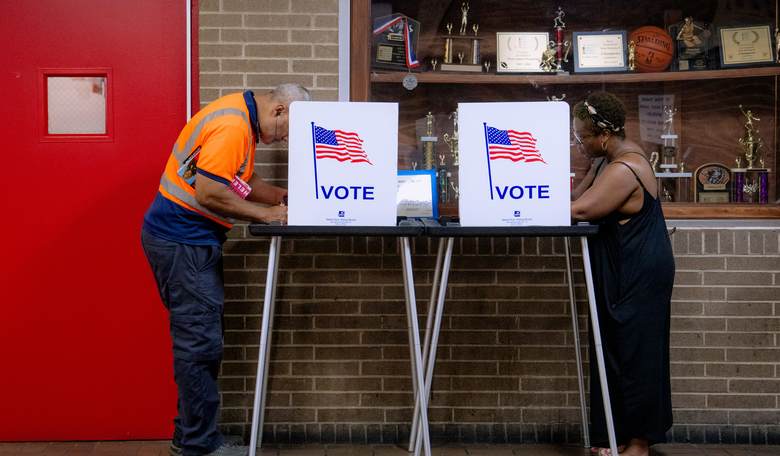
Veterans Day isn’t for another few weeks, but it’s worth taking a closer look at veterans in the run-up to the November 3 elections. There are just under 17 million living veterans in America, according to the U.S. Department of Veterans Affairs, comprising about six percent of the electorate. In a close election, they can determine the outcome of any given contest.
Veterans overwhelmingly favored Donald Trump in the last presidential election. A September 30, 2024, survey by Pew Research showed a +24 advantage for Trump over Kamala Harris two years ago. But these midterm elections are very different, given the number of candidates up and down the ballot who openly campaign on socialist issues and who are adjacent to extremist Islamist organizations. Why does this matter?
Of those 17 million veterans, about 30,000 served during World War II. Most of the remainder fought in Korea, Vietnam, the Cold War, and various Middle East conflicts including the Gulf War era, and post-9/11 conflicts in Iraq, Afghanistan, and elsewhere. In every war since 1950, Americans fought against socialism, communism, and an Islamist ideology that promoted global terrorism. The men and women taking up arms against these schools of thought over the past half-century watched their buddies die in combat, suffered the privations of armed conflict, and stood against the enemy with resolve.
Veterans don’t forget their enemies. As a Cold War veteran from the 1970s and ‘80s, I vividly recall hunting Soviet nuclear-armed submarines in the North Atlantic, watching Soviet-made Libyan fighter jets fire on warships in the Gulf of Sidra, and spending more than two months on-station off the coast of Iran in the Arabian Sea. They were prepared to kill us, and we were prepared to kill them. That’s how war works.
Today, ideologies that animated our enemies over the past 75 years are on the ballot, a fact not likely lost on veterans. The Democratic Socialists of America website lists more than 150 candidates and ballot initiatives they’re supporting this year. The political arm of the Council on American-Islamic Relations (CAIR) website lets people search for its endorsements and preferences state-by-state. Where I live in Texas, CAIR is a designated foreign terrorist organization, along with the Muslim Brotherhood. These people are telling us how to vote.
For its part, the Muslim Brotherhood is smart enough not to endorse American politicians, but the group has placed Michigan Senate nominee Abdulrahman Mohamed El-Sayed in an uncomfortable position. Between his own public expressions of sympathy for the organization and more direct connections among some of his extended family, it raises legitimate questions.
This has absolutely nothing to do with what El-Sayed looks like, how he prays, or how his name is spelled. It has everything to do with his pursuit of power over foreign relations should he win his election. He’s already explicitly said Israel is neither an ally nor friend, a highly provocative statement given that the United States was the first government on earth to recognize the nation of Israel in 1948. We’ve been allies ever since.
How veterans will respond to these midterm election dynamics is unclear. Some will undoubtedly pull the lever for some of these candidates, but a lot of them, probably many more of them, will think to themselves, ‘Wait, didn’t we go to war with these ideas?’ People who believed many of the same things embraced by American politicians today wanted to kill them when they were in uniform. Now, they’re asking for our vote.
American veterans can be among the most forgiving people among us, including forgiving their past enemies. That’s because veterans of all nations understand they fought for what they believed while their opponents fought for what they believed. This trait is both martial and biblical. Jesus Christ’s prayer in His Sermon on the Mount specifically instructs us to forgive those who trespass against us, and veterans are apt to accept that.
Just as veterans remember their enemies, I also recall my exchange with a provincial lieutenant governor in Kazakhstan in 2000. During a dinner conversation one night in the Kokshetau Province, we learned that we both served in our respective submarine fleets many years before, he being a Soviet submarine officer and I an enlisted navigation technician. He then interrupted the dinner, and we raised vodka toasts to each other for being worthy adversaries who now share friendship and diplomatic relations. The dinner guests applauded. That’s how peace works.
But the politicians who embrace socialist policies or express Islamist sympathies don’t seem interested in peace. Democrats are not the enemy of Republicans; they are opponents. But from denouncing our allies to threatening young people working in a Republican administration and seeking to dismantle the Constitution, there are candidates who cling to the ideologies of our enemies. With luck, the six percent of voters who wore the uniform can defeat them at the ballot box.