
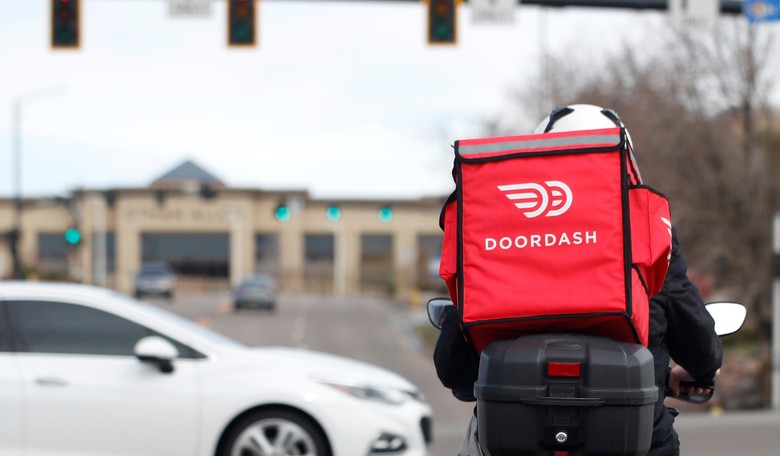
DoorDash has announced it plans to purchase Instacart for $17 billion, one week after Amazon said it will partner with Uber Eats to provide food delivery services for millions of Amazon Prime members.
DoorDash says its deal with smaller competitor Instacart would give consumers and local grocers a scaled alternative to the delivery networks Amazon and Walmart are building for themselves.
On Nov. 5, Amazon and Uber said U.S. Prime members can now order restaurant meals from Uber Eats directly on Amazon.com and in the Amazon Shopping app, with no delivery fee on orders of $25 or more.
The arrangement replaces Amazon's restaurant partnership with Grubhub, which ended the same day, according to an Amazon spokesperson quoted by TechCrunch. One week earlier, on Oct. 29, DoorDash agreed to buy Instacart for $65 a share in cash and stock.
The Amazon-Uber pact puts Uber's courier network behind Amazon's Prime membership, joining Walmart as a retail giant that sells fast delivery as part of a membership. Supporters of the DoorDash-Instacart deal say a combined company would be the main alternative for shoppers and stores outside those two ecosystems.
The moves come as Americans shift more of their food spending online. Online grocery sales rose 20.7% in the third quarter from a year earlier and captured a record 20.9% of total U.S. grocery spending, according to analytics firm Brick Meets Click. Delivery accounted for about three-quarters of that growth. In September, nearly 64% of U.S. households bought groceries online, also a record.
Walmart and Amazon have taken the largest gains. Brick Meets Click said in June that Walmart is approaching 40% of U.S. online grocery sales. Amazon has added fresh groceries to its same-day network and offers 30-minute delivery in some cities through its Amazon Now service.
In third-party delivery apps, DoorDash is the clear leader. Card-spending estimates from Consumer Edge put DoorDash at roughly 59% of third-quarter spending across major U.S. delivery apps, with Uber Eats and Instacart at about 18% each.
DoorDash argues in its merger announcement that the nation's biggest retailers are building their own delivery fleets, warehouses, membership programs and AI shopping assistants. DoorDash says that grocers running on thin margins cannot build such systems alone.
Under the deal DoorDash would pair its courier network with Instacart's software, which already runs online stores and advertising for more than 2,200 retail banners. Regional supermarkets without Walmart's or Amazon's scale could use both, rather than lose online shoppers to the two giants.
DoorDash said its deal would allow grocers to keep working with any delivery platform, with no grocery exclusivity, and that Instacart shoppers could keep working only on Instacart. Instacart customers would gain access to more than 50,000 additional stores, and DashPass and Instacart+ members would pay one fee instead of two, saving an estimated $100 million a year, the company said.
"It's still early innings, but we know that when more people shop local, more dollars stay local," said Tony Xu, DoorDash co-founder and CEO. The Amazon-Uber pact adds weight to the scale argument. A Prime member can now order an Uber Eats dinner and same-day Amazon groceries in one app. Merger supporters say the DoorDash deal would provide a third large service competing for the same households: Amazon and Uber, Walmart, and the combined DoorDash-Instacart.
Under the Amazon agreement, the company would handle ordering, payment and status updates, while Uber Eats supplies the restaurants and couriers. Prime members will not need an Uber account. The companies said the benefit reaches nearly 10,000 U.S. cities and towns, and Amazon estimates frequent users could save more than $175 a year, more than the $139 annual Prime fee. Service fees still apply.
"This is what Prime is all about: unlimited free, fast delivery on a wide selection of products, big savings, fantastic entertainment, and now even more value on restaurant delivery with Uber Eats, all in a single membership," Jamil Ghani, worldwide vice president of Amazon Prime, said in the companies' joint announcement.
Uber's delivery business was growing quickly before the deal. Delivery gross bookings rose 22% to $28.5 billion in the third quarter, and the segment's operating income rose 30% to $1.06 billion, the company reported Nov. 4.
By comparison, DoorDash's purchase of Instacart would combine the leading restaurant delivery app with the largest independent grocery delivery platform, which works with more than 2,200 retail banners covering nearly 100,000 stores. The $65 price is a 26% premium to Instacart's Oct. 22 close, the last trading day before media reports of talks.
DoorDash says it plans to keep the Instacart brand and app. The deal needs Instacart shareholder approval and regulatory clearances, and the companies expect it to close at the end of 2027 or in the first half of 2028.
"Grocery is one of the hardest things to get right online. Someone has to pick a ripe avocado, find a substitute you'd choose yourself, and get the ice cream to you before it melts," Xu said.
Both companies reported strong third quarters on the day of the announcement. DoorDash revenue rose 34% to $4.6 billion and orders rose 28% to 993 million, figures that include its Deliveroo acquisition. Instacart's gross transaction value rose 15% to $10.5 billion, orders rose 10% to 91.4 million and advertising revenue rose 23% to $331 million. Instacart suspended its financial guidance pending the merger.
"Online grocery is still an under-penetrated category, and we're in the early stages of realizing what our purpose-built grocery technology can do to transform it," Rogers said in Instacart's earnings release.
Financial analysts have noted that the DoorDash-Instacart merger could draw antitrust scrutiny, and the deal needs clearance under the Hart-Scott-Rodino Act as well as approvals in Canada and Israel.
The outcome may turn on how regulators define the market. Measured only among delivery apps, the combined company would be the largest. Measured across all online grocery, where Walmart alone approaches 40% of sales, it would face larger rivals.
The deals are part of a change in consumer behavior relating to meals and groceries. Amazon is folding restaurant meals into Prime, Walmart has about 2,400 restaurant locations on its delivery platform, and DoorDash is pairing grocery with DashPass and adding Lyft rides.
If regulators include the giants as part of the relevant market, a combined DoorDash and Instacart could stand as the main independent alternative for shoppers and local grocers. If they focus on delivery apps alone, the deal faces different questions, with a decision not expected before late 2027.