
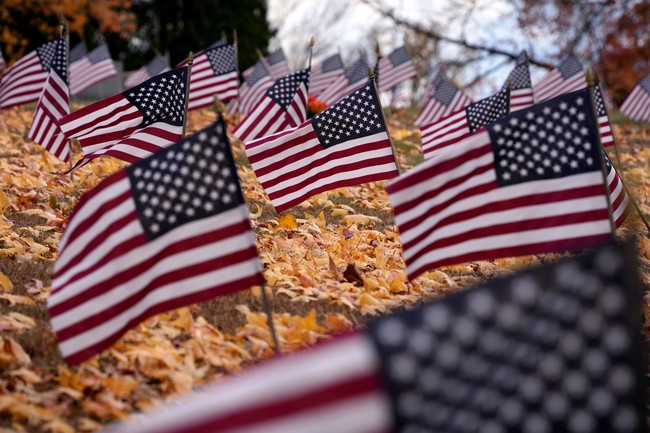
All Americans should count their lucky stars that they live in a country with men and women ready to sacrifice it all to defend freedom. Unlike its cousin, Memorial Day, the upcoming Veterans Day holiday celebrates all of those who served, not just those who gave the last full measure of devotion. From Bunker Hill to the Somme, to Guadalcanal and Normandy, the Chosin Reservoir, Khe Sanh, Fallujah, and countless other lesser-known engagements, as well as in thousands of peacetime locales, Americans have served for duty, honor, and country.
On this Veterans Day, I urge you to say thank you to those who have served — only about 6 percent of the population has that distinction, and that is down from about 20 percent in the 1980s. The great legacies written through military service are too many to cover in one article. Stories about Medal of Honor recipients and others drawn from the battlefields are awe-inspiring, but many other tales remain unknown, told about people who never actually heard a shot fired in anger. Yet they too serve the country in support roles far from the limelight. The military sentry guarding the demilitarized zone between North and South Korea, for instance. Or the shore parties tasked with maintaining ships returning from deployment, or payroll and mail clerks, computer programmers, logisticians, staff planners, and countless others who make sure the combat troops are well cared for. All these folks served their nation and deserve honor and respect on Veterans Day. Combat units have a special place of honor, rightfully sanctified in the public’s consciousness, and they deserve all the gratitude a non-serving public can give. But thankfulness is not enough.
What does proper gratitude look like? When someone says to a vet, “Thank you for your service!”, what does that mean? There is no doubt that I, as a Vietnam-era and Cold War fighter pilot, would much rather hear that than encounter the campus radicals and anarchists who spit upon us in the ’60s and ‘70s.
Lance Sijan (April 13, 1942–January 22, 1968) was a remarkable individual who left a legacy worth living. After graduating from the U.S. Air Force Academy in 1965 and then jet pilot training, Sijan flew 52 combat missions in the F-4C Phantom II fighter in Vietnam. He was shot down on November 9, 1967, and evaded capture by the North Vietnamese for nearly six weeks while stricken with disease, a fractured skull, a mangled right hand, and a compound fracture of the left leg. He had earlier called off an attempted rescue by pararescue jumpers, fearing they would be captured as well. Emaciated and suffering terribly, he was finally captured and then shockingly escaped from his captors into the jungle for a few hours. Re-captured, he valiantly resisted brutal interrogations and torture and never revealed any information to his captors. Two fellow POWs witnessed his valor as they ministered to him as best they could under the most austere conditions. He died in captivity about one month after his capture.
In 1974, President Gerald Ford posthumously awarded Sijan the Medal of Honor for his actions. The Lance P. Sijan Leadership Award remains a highly prized honor given to a small number of U.S. Air Force service members who exhibit heightened leadership qualities in the spirit of Captain Sijan. One of the most cherished memories of my military career was when I received the Sijan Award as a major command recipient. I remain humbled 40 years later by the award honoring Lance Sijan, a true American hero. I have often wondered: had he lived and been repatriated as part of Operation Homecoming (February 12 and April 4, 1973), would he have reentered a society ready to help him overcome the many years of additional mental and physical torture and isolation he certainly would have endured? Sadly, I think not.
Today, there are still too many vets suffering from PTSD who are not getting the treatment they deserve. In fact, almost 18 veterans across the nation take their own lives each day, and that number may be underreported. Credible studies show that enrollment with the Veterans Health Administration (VHA) and its care programs has a dramatically positive effect on inhibiting these unnecessary deaths. The VHA under President Trump and Secretary Collins is making real progress, and kudos to them for tackling this heart-rending situation. Interestingly, according to a VHA study released a few weeks ago, veteran suicides have declined by 4.8 percent overall in 2023-2024 for those enrolled in a VHA program, the latest years available, and that is promising. Yet they have increased by an estimated 3.7 percent for those not enrolled in the VHA system. Engaging veterans through VHA counseling and healthcare programs makes a difference — endemic connection seems to be a prescription that is reifiable. For instance, the VHA’s RISK ID program is an interventionist program designed to screen veterans and assess their susceptibility to conditions leading to a potential suicide, and it is a crucial tool.
We should support programs that work, volunteer at veteran organizations, encourage more grassroots funding of veteran groups, and help veterans get jobs. Veteran homelessness and unemployment are unacceptable in the greatest nation on God’s green earth. Yet there are an estimated 32,000 homeless vets — and that is based only on those who are known through tracking programs. I am not advocating that veterans should get a free ride — I do not believe they want that. As someone once said, “they want a helping hand, not a handout.” The veteran unemployment rate is about 3.5 percent, which is less than the non-veteran rate, but it’s too high given the high level of experience a military veteran has — transitioning those skills to the private sector presents a major hurdle. A closer look suggests veteran employment issues are rife with underemployment: the inability to replicate military income and the pressure to accept lower-paying jobs just to enter the civilian workforce.
The award-winning movie "The Best Years of Our Lives" is a terrific, vintage work of mimesis that elegantly portrays issues facing vets. So, when you encounter a vet this Veterans Day and every day, please continue to say, “thank you for your service,” but then go above and beyond. Support legislation to end veteran homelessness and empower employment, and demand politicians use their platforms to dramatically reduce suicide rates. And importantly, motivate young men and women to join the military, so we put the best we have on the ramparts and salients, remaining watchful and stoic, ready at the siren’s notice to throw themselves selflessly into the fray. Those are consequential steps toward assisting those who were and who now are willing to die for you and me — that substitutionary act is exactly what Jesus did.
David Holmes is Executive Vice President and Chief Legacy Officer at First Liberty Institute, and a former Air Force fighter pilot who also served as an aide to former Vice President Walter Mondale during his tenure as U.S. Ambassador to Japan.