
Nike built an iconic brand by selling performance, not politics. So what happened when politics became part of the product?
For a generation, Nike rose on product innovation, sharp marketing, and a short list of athletes who made millions of customers want what they wore. Michael Jordan built the Air Jordan into an American franchise. Kids did not buy those shoes because Nike had a political theory on social engineering. They bought them because the shoes represented winning.
Who could have predicted that the creator of the Air Jordan would ever fly right out of the S&P 100?
That is no longer a hypothetical. On September 21, S&P Dow Jones Indices removed Nike from the S&P 100 after nearly 18 years.
This was not a political ruling by an index committee. It was a market-cap verdict. In November 2021, Nike peaked with a valuation approaching $280 billion. It’s now worth about $55 billion. More than $200 billion in shareholder value is gone. It’s fair to look at why.
Nike can point to other business factors. China’s market for the once dominant brand cooled. Competitors took shares through innovation and design. A digital-first strategy strained its shoe store partners. Too much of the Nike lineup was old product, sold again.
A serious review does not deny any of that. But it also does not stop there.
A string of high-risk political positions pushed the brand closer to the edge — decisions that had nothing to do with making a better shoe, signing a better athlete, or delivering better returns. The costs did not appear on the balance sheet under a line item called “politics.” They appeared as reputational damage, lost customer goodwill and, ultimately, lost business.
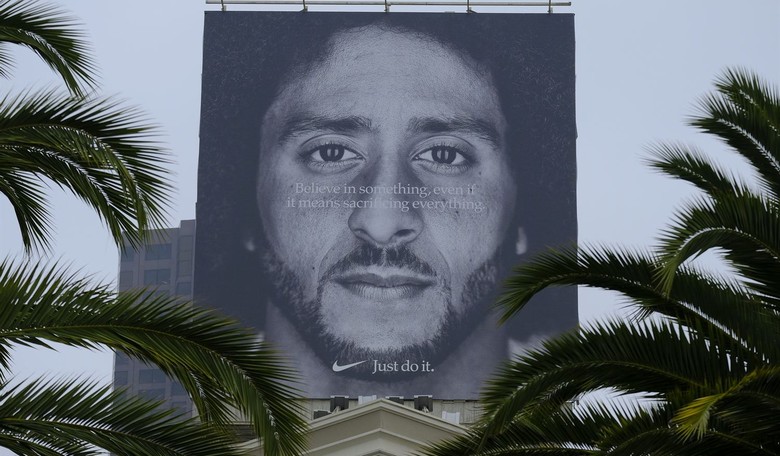
The record is very public. In 2018, Nike made Colin Kaepernick the face of its anniversary campaign and treated a shoebox like a soap box. A year later it doubled down by pulling a Betsy Ross–flag sneaker after Kaepernick objected to a founding-era symbol on a patriotic shoe. That was leftist politics exercising a very public veto over an American consumer brand.
After 2020, Nike went further. It set racial representation targets, built race-conscious mentoring and leadership programs, and tied internal incentives to DEI metrics. Those choices are now the subject of an EEOC investigation alleging discrimination against white employees and applicants.
Then came gender politics. Nike scored a perfect 100 on the Human Rights Campaign’s Corporate Equality Index, where 100 means way left. Nike partnered with Dylan Mulvaney of Bud Light fame to sell women’s apparel and covers gender-transition coverage for its employees. That is not a side issue for a brand that spent years selling itself as a champion of women’s sports. You cannot market “Play Like a Girl” with one hand while blurring the line between men’s and women’s competition with the other, and then act surprised when customers notice.
Shareholders have begun to ask fiduciary questions. Nike’s board recently convinced investors to reject a shareholder proposal seeking a report on the legal and reputational risks of Nike’s advocacy partnerships. The vote did not settle the risk; it showed management would rather defend the politics than shelve them.
At the Free Enterprise Project (FEP), we have seen this pattern before. Boards can mistake activist pressure for shareholder interest and confuse social fashion with fiduciary duty. In 2024, FEP supported a congruency report at Nike on divisive partnerships for a simple reason: When a consumer brand picks a political side, it should expect to lose the customers it alienates.
Was the S&P 100 exit inevitable the day Nike’s first political campaign launched? No. The Kaepernick ad did not, by itself, erase $200 billion. The stock kept rising until 2021. That fact is not a defense. It is a timeline. Later political bets landed on a company already struggling with product and distribution. Politics did not have to be the only cause to be a foreseeable one. Reputational harm compounds, weakening customer loyalty when the business needs it most.
A shoe company exists to inspire people to move, not tell them what to think. When Nike made politics part of the product, it told a large share of its audience that their values were the problem. Most didn’t protest. They just stopped buying.
Nike can keep pointing to China, bad wholesale strategy, and weak innovation. That’s certainly a part of the story. But a string of high-risk political positions took the brand closer to the edge than necessary.
Curtis Hill is Senior Advisor to the Free Enterprise Project of the National Center for Public Policy Research, a Project 21 ambassador, and former Indiana Attorney General.