
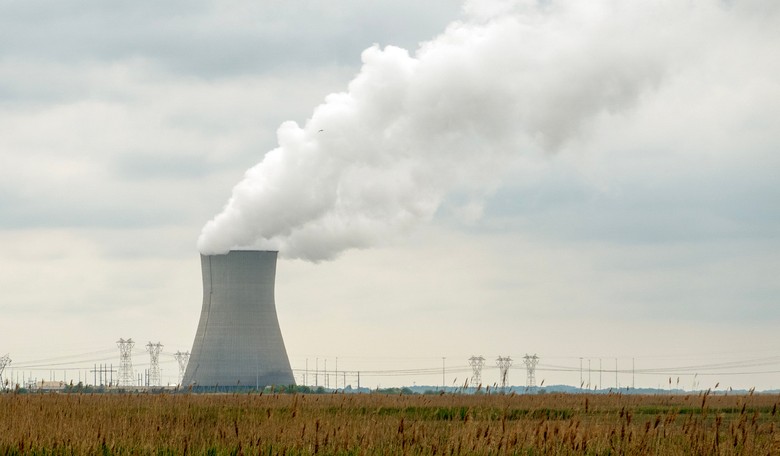
In a recent article, I compared today’s hue and cry against AI and data centers to the anti-nuclear campaigns that halted U.S. nuclear energy development four decades ago. Now others are picking that theme, most recently Michael Waller in National Review. Meanwhile, the anti-nuclear crowd continues to use the threat of nuclear war as a weapon against U.S. (but not Chinese) use of nuclear energy to power AI-driven data centers.
While Waller points to Democratic Socialist Bernie Sanders opposing AI in partnership with Randi Weingarten, whose American Federation of Teachers helped slam the door on nuclear energy in the 1980s, the Bulletin of the Atomic Scientists spreads fear that today’s AI systems “can cause nuclear war even if people nominally remain in charge.”
Way back in 2011, I wrote a review of Deep Green Resistance, whose authors argued that “the enlightened few must rise up in resistance – not to reform, but rather to totally tear down the corporate capitalist economic system and even civilization itself as we know it.”
In the review, I cited a communique from Arab Spring leaders in Egypt, lauded by the Occupy Wall Street movement, that endorsed Sharia Law as necessary “to ensure that … people never embrace the comforts (or equal rights) of Western civilization. The rationale? “An entire generation across the globe has grown up realizing, rationally and emotionally, that we have no future in the current order of things.”
The Chinese do not believe this, nor do people worldwide eager to embrace human progress. True, many do ask whether they will be among the beneficiaries. But blockchain backed by AI has opened the doors for the democratization of finance so that even the world’s poorest can participate in wealth building.
While the hatred of human progress has indeed infected American youth, some of whom long for the “simplicity” of life in places like Cuba, the ascendance of artificial intelligence (built on collective human intelligence) has multiplied the numbers of the fearful to the delight of America’s competitors for world domination (or mutually assured existence).
It is, of course, important that humanity not lose itself in technology – exporting the human brain into a machine body in search of immortality, for example. Children should learn about the natural world through personal experience — learning rudimentary human progress (fire, the wheel, etc.) before tackling the complexities of the modern and emerging eras.
As the late Julian Simon said, “The ultimate resource is people… who will exert their wills and imaginations for their own benefit, and so inevitably they will benefit the rest of us as well.”
To that end, the Trump administration, by eliminating anti-growth regulations, has again unleashed American ingenuity to revitalize the U.S. nuclear energy industry to supply the electricity needed to further develop emerging technologies like AI, robotics, and space travel.
The fact that AI-driven data centers have sparked the need for additional electric power generation, coupled with the public (and Presidential) demand that these centers supply their own power, is a driving force behind the 20-year nuclear power agreement just announced between Google and Constellation Energy that will boost output at 11 existing reactors across Illinois, New Jersey, and Pennsylvania.
As first reported in The Wall Street Journal, the deal centers on an 890-megawatt, $4.3 billion power purchase agreement to boost output at 11 existing reactors, in what Constellation is calling the largest ever uprate project between a nuclear power provider and a tech company. The two companies also struck a 15-year supply deal to add another 2,700 MW of electricity in the 13-state PJM power market.
Constellation had earlier announced a $1.6 billion deal with Microsoft to restart one reactor at Three Mile Island, which has been dormant since 2019. As Lucas Nelson reports, Microsoft needs electricity to power its AI and machine learning applications, as data centers, which form the backbone of these technologies, require vast amounts to operate.
The Trump administration promised regulatory reform and other support for the nuclear industry, in part because of the rapidly growing need for reliable energy for these emerging technologies and in part to augment supply in rapidly growing areas of the nation.
Just last month the Department of Energy’s Office of Energy Dominance Financing closed a loan of up to $1.9 billion with NextEra Energy to help finance the restart of the 615-MW nuclear power plant at Duane Arnold Energy Center in Iowa.
A week later the Nuclear Regulatory Commission authorized Holtec to begin early construction work for two planned small modular reactors at the Palisades Energy Center in Michigan that are to deliver a combined 680 MW of electricity. Holtec is also working to restart the existing nuclear power plant at the Palisades site.
Meanwhile, NuScale Power, in partnership with ENTRA1 Energy, is in negotiations with the Tennessee Valley Authority toward what could become the largest nuclear power deployment program in U.S. history. The proposed project could range from 6 to 8 gigawatts of generating capacity from small modular reactors using factory-built modules that can be deployed quickly and expanded over time.
Even local governments are getting into the act. CORE POWER and the Port of Corpus Christi Authority just signed a Memorandum of Collaboration to establish a framework for a site-specific maritime nuclear readiness study at the Port of Corpus Christi. The study will examine how a major U.S. energy and trade gateway could serve as both a potential location for a floating nuclear power plant and as a gateway for future calls by nuclear-powered commercial ships.
Add to this the myriad of private sector financed nuclear energy projects, including fusion projects. Investment dollars are once again flowing into nuclear energy, much of it (especially for small modular reactors) aimed at providing power for data centers.
One caveat. Should the anti-progress hysteria result in a major political defeat for those backing this revival of nuclear technology and its support for AI, robotics, machine learning, and the data centers that keep them operating, all bets could be off.