
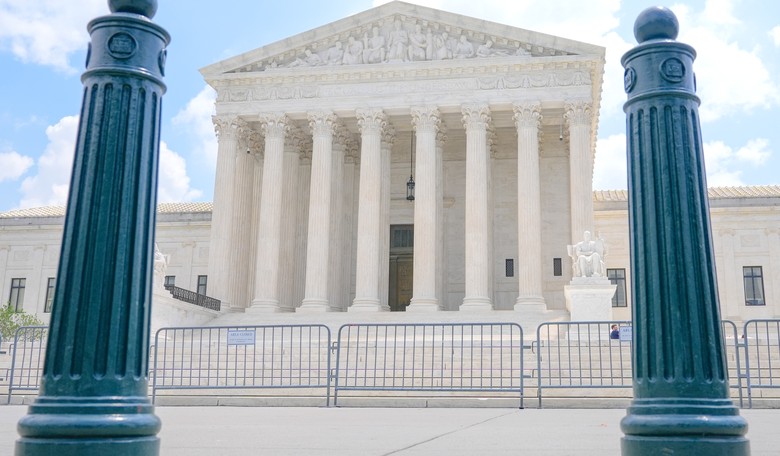
The Supreme Court is declining to hear cases involving COVID vaccine mandates, Second Amendment rights, and two brothers’ right to wear ‘Let’s Go Brandon’ sweatshirts. Those are the top cases, though the Court refused to hear arguments in hundreds of others. Before we get all juiced up about the gun cases, they stem from a case about whether habitual drug users are prohibited from owning firearms.
Look, this case has some interesting aspects, but it’s not the hill to die on right now. It doesn’t address ‘shall issue’ or ‘may issue’ questions about concealed carry, nor does it address whether the Constitution permits carrying handguns outside the home for self-defense, which the Bruen case finally decided. Yet that took over a decade, with similar questions about carry laws and justifiable need clauses challenged and rejected by the Court for oral argument.
Sadly, the Supreme Court won't hear arguments in a case involving the Let’s go Brandon sweatshirts. The nine justices chose to uphold a lower 6th Circuit ruling, under which the panel deferred to a school district’s right to curb vulgar speech, even when it’s cloaked in an innocuous slogan. I’m not so sure about that, as it’s not like these kids wore a hoodie with a swastika to school. Then again, it’s not a be-all-and-end-all free speech case. On the COVID vaccine mandates, the Court heard from a group of firefighters in Seattle who sought a religious exemption from the mandate, which it rejected on the grounds that it would create an undue hardship for the employer. The case turns on what constitutes undue hardship, and the criteria for determining whether granting that religious exemption would be unreasonable. The firefighters argued they were being discriminated against, but a judge ruled for the department, and the 9th Circuit upheld that ruling, which remains in place. It stated that an employer must only show “a reasonable concern of undue hardship” to reject a religious accommodation or exemption. SCOTUSBlog had a lengthy and detailed rundown of the docket that didn't quite make it this term (via SCOTUSblog):
Before the justices took the bench on Monday for the first oral arguments of the 2026-27 term, the Supreme Court issued a list of orders from the justices’ private conference on Sept. 28, where they considered petitions for review that built up during the summer recess. As it does each year, that “long conference” produced a lengthy list of denied petitions. The justices denied review in hundreds of cases, including a high-profile dispute over whether schools may bar students from wearing sweatshirts printed with the phrase “Let’s Go Brandon,” a clash over the Second Amendment rights of convicted felons, and two battles over COVID-19 vaccine mandates.
In Monday’s order list, the justices also asked the United States solicitor general to share the government’s views on several cases and sent several others back to the lower courts for reconsideration in light of rulings from last term. For example, in Mullin v. National TPS Alliance, the Supreme Court ordered a federal appeals court to take another look at its decision on Venezuelans’ and Haitians’ participation in a program that allows foreign nationals to remain in the U.S. and work here when they cannot safely return home after the court held in June that the federal law creating the Temporary Protected Status program generally bars courts from reviewing the administration’s program-related decisions.
[…]
COVID-19 vaccine mandates
Three years ago, in Groff v. DeJoy, the Supreme Court ruled an “undue hardship” is one that imposes a “substantial” burden “in the overall context of an employer’s business.” On Monday, the Supreme Court denied review in Petersen v. Snohomish Regional Fire and Rescue, a dispute over the standard that employers must meet to justify denying an employee’s request for a religious accommodation.
The case stems from the mandate, imposed by Washington state in 2021, that healthcare workers be vaccinated for COVID-19. The plaintiffs, eight firefighters for Snohomish Regional Fire and Rescue, requested an accommodation from that requirement based on their religious beliefs, but the department determined that it could not provide the accommodation.
The firefighters went to federal court in Seattle, where they argued that the department’s failure to accommodate their religious beliefs violated federal and state anti-discrimination laws. A federal judge ruled for the department, and the U.S. Court of Appeals for the 9th Circuit upheld that decision. A three-judge panel agreed that the fire department would have faced an “undue hardship” if it were required to accommodate the firefighters’ request for an exemption from the vaccine requirement. “The objective, unrebutted medical evidence shows that SRFR would have faced significant health and safety costs by allowing unvaccinated firefighters to continue working, even with accommodations,” the panel wrote. And “SRFR,” the panel continued, “could not afford to have substantial numbers of its firefighters on sick leave.”
The firefighters came to the Supreme Court in April, asking the justices to weigh in. They framed the question presented by the case as whether the employer must show that the undue hardships are “real or whether good-faith but mistaken fears of such hardships” are enough. In this case, they say, they had contested the fire department’s claim that accommodating their religious beliefs with an exemption from the vaccine requirement would cause undue hardship. Among other things, they had “pointed out that SRFR did not experience any hardship either before or after the brief period in which it enforced its vaccine mandate”; moreover, they added, neighboring fire departments had provided an exemption from the vaccine mandate without any problems.
The 9th Circuit, the firefighters said, along with two other circuits (the 1st and the 6th), only requires an employer to show “a ‘reasonable concern’ of an undue hardship to justify denying a religious accommodation.” By contrast, the firefighters argued, three other courts of appeals – the 3rd, 7th, and 8th – hold that the employer must actually “prove undue hardship arising from the accommodation.”
Other cases that were rejected this term:
- Thompson v. Wilson, in which a lobsterman in Maine, Frank Thompson, had asked the justices to hold that a state rule requiring federally permitted lobstermen to carry a tracking device on their vessels that collects location data once per minute anytime the vessels are in use, violates the Fourth Amendment’s ban on “unreasonable searches and seizures.”
- Reel v. North Carolina, on whether “knock and talk” visits – during which investigators visit a potential suspect’s home and knock on the door, hoping to draw the individual into a revealing conversation or be invited inside – constitute a search within the meaning of the Fourth Amendment.
- N.R. v. Ellison, in which the former foster parents for Indian fraternal twins challenged the constitutionality of the Indian Child Welfare Act and Minnesota Indian Family Preservation Act.
- Balwani v. United States, involving Elizabeth Holmes’ co-defendant and former romantic partner, Ramesh Sunny Balwani. Balwani urged the court to review a federal appeals court’s handling of his claims that his trial involved false testimony and that the trial court failed to guard against prosecutors’ reliance on false testimony.
- Roof v. U.S. District Court for the District of South Carolina, in which Dylann Roof, who was convicted of killing nine Black churchgoers during a mass shooting at Emanuel African Methodist Episcopal Church in 2015, contended that the federal district judge that presided over the proceedings in his case had not acted impartially.
- Moore v. Senate Majority PAC, in which Roy Moore, the former chief justice of the Alabama Supreme Court, appealed a ruling from the U.S. Court of Appeals for the 11th Circuit that prevented him from collecting a $8.2 million jury award in his defamation case against Senate Majority PAC over a campaign ad that said he had “solicit[ed] sex from young girls.”
- Mulkey v. Alabama, involving Steven Richard Mulkey, who is on death row in Alabama. Mulkey asked the court to take up his case and hold that the trial court judge had violated his right to an impartial jury by publicly sanctioning a prospective juror in front of other prospective jurors. Justice Sonia Sotomayor wrote a statement respecting the denial, in which she concurred in the denial but emphasized that “judges should limit exposing a jury to collateral proceedings, particularly when those proceedings might frighten or intimidate the jury.”
- Norfolk Southern Railway v. Mallory, in which the court declined to decide whether Pennsylvania violates the Constitution (including the commerce clause) when it allows a lawsuit – brought by an out-of-state plaintiff against an out-of-state company and involving claims that have no relation to Pennsylvania – to go forward in its courts. The Supreme Court left this question open three years ago when this case first came to the justices; they ruled then that the state did not violate the defendant's right to due process when it allowed the defendant to be sued in its courts based on its registration to do business in Pennsylvania.