
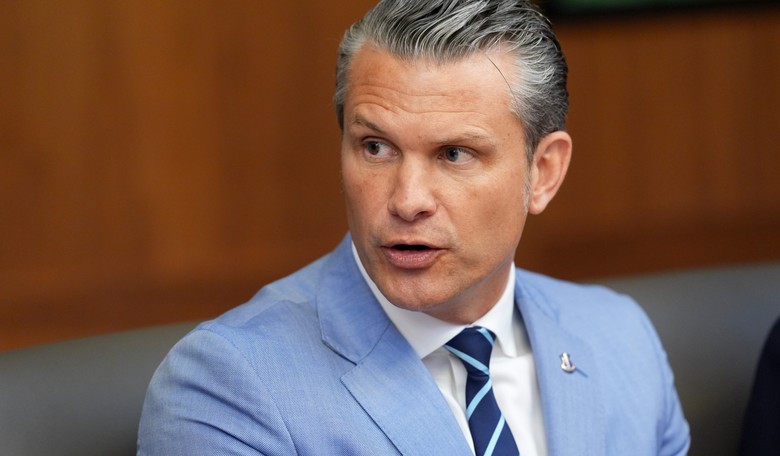
Secretary of War Pete Hegseth delivered his state of the force address at Quantico today, where he announced a new command structure to oversee military drone technology, a retooling of the officer corps, and laid out plans to build a war machine that isn’t engulfed or “encumbered” by bureaucratic details and woke nonsense. It comes a year to the day after his thrashing of the brass for adopting and pushing woke policies that he feels have hobbled the military. Another officer reorganization is also coming (via CBS News):
Defense Secretary Pete Hegseth said in a speech on Wednesday that the Pentagon is eliminating roughly 1 in 5 generals and admirals during the second Trump administration through firing or position cuts, following through on Hegseth's pledge to fundamentally change how the Pentagon operates.
Hegseth said he's aimed for the department to be "unrelenting, unapologetic, and uncompromising" in its mission to win. Generals who "clung to the woke department or seem to think civilian control of the military is simply a suggestion, well, they no longer work here," Hegseth said.
"The number crunchers say we fired 10% of the generals and admirals across the force, and that number sounds about right," Hegseth said. "And I know because I directed it that we've also reduced the overall number of general officer slots by an additional 10%. So yes, 20% reduction across the board. Now the media calls that a purge. I call it accountability, and long overdue."
SecWar Hegseth is CLEANING UP wokeness in the military.
— Townhall.com (@townhallcom) September 30, 2026
"No more silly PowerPoint training or drag queen shows... only the warrior ethos..
No fatties, no trannies, no beardos, no weirdos, no wimps, no radicals." pic.twitter.com/gAM1bvGCcz
SecWar Hegseth:
— Townhall.com (@townhallcom) September 30, 2026
"Recruiting for every branch has been record-setting ever since President Trump won in November of 2024...
Americans want to serve when they are led by strong patriots, not by weak weirdos." pic.twitter.com/teSDn6YJPw
HUGE!
— Townhall.com (@townhallcom) September 30, 2026
SecWar Hegseth announces the start of Project Meridian, "an effort led by America’s best minds to study the future of warfare... Project Meridian will be co-led by three of our nation’s best minds: Elon Musk, Palmer Luckey, and Newt Gingrich." pic.twitter.com/B6iMyLGFT9
“No fatties, no trannies, no beardos, no weirdos, no wimps, no radicals,” said Hegseth. And no more drag queen PowerPoint presentations. That line will likely trigger a liberal meltdown.
But the drone technology announcement, Project Meridian, was the real story (via WSJ):
The Autonomous Warfare Command, or “AutoWarCom,” will be directed to buy new drones and robotics “in the fastest peacetime shift in modern military history,” Hegseth said in a speech at U.S. Marine Corps Base Quantico, Va. The command is set to be functional in October of 2027.
Hegseth also announced in a speech to the troops that he is tasking entrepreneurs Elon Musk and Palmer Luckey and former House Speaker Newt Gingrich to study the future of warfare. Called “Project Meridian,” the effort would be led by the Pentagon to uncover new ideas about how future generations will fight. Their findings would be due in 120 days.
On the autonomous-warfare command, Hegseth is initially tapping Owen West, a former Marine, assistant defense secretary and Goldman Sachs trader, as well as Max Strasiser, a Navy SEAL test pilot who has built robotic systems in combat. A four-star military officer, yet to be named, would eventually take over.
A top priority is to rapidly establish an American-made pipeline of cheap, unmanned systems so that the U.S. can adapt as quickly as Ukraine in the event of a war, West said in an interview with The Wall Street Journal.
“Once we apply sustained budget to changed doctrine, we will outperform the world,” said West, who has been leading the Pentagon’s Defense Innovation Unit. “And by snapping in AI, we will be ahead of the world, because we are the leaders in AI.”
[…]
Hegseth has already consolidated many of the Pentagon’s drone and autonomous systems under a single office that he established in June. Now, he is directing that office to lay the groundwork for the combatant command by launching “Project Agincourt,” which West and Strasiser will lead.
[…]
Unveiling Project Meridian, Hegseth said the Pentagon’s chief technology officer, Emil Michael, will work with Musk, Luckey and Gingrich. “On any future battlefield, from under the earth to beyond the moon, our American warriors will be armed with absolute technological superiority because we will have the foresight to prepare today for tomorrow,” Hegseth said.
Separately, Hegseth announced a new high-level office in charge of hardening military installations from attacks on civilian infrastructure. The office, dubbed “Fortress America,” will be headed by a senior civilian and a two-star military officer, according to a memo reviewed by the Journal.
The effort calls for every major military installation in the U.S. to generate its own power, independent of the civilian energy grid, Hegseth said during the address. It will also move to strengthen U.S. supply chains and the defense industrial base, and harden military installations against sophisticated cyber and drone attacks.
Outstanding work.