
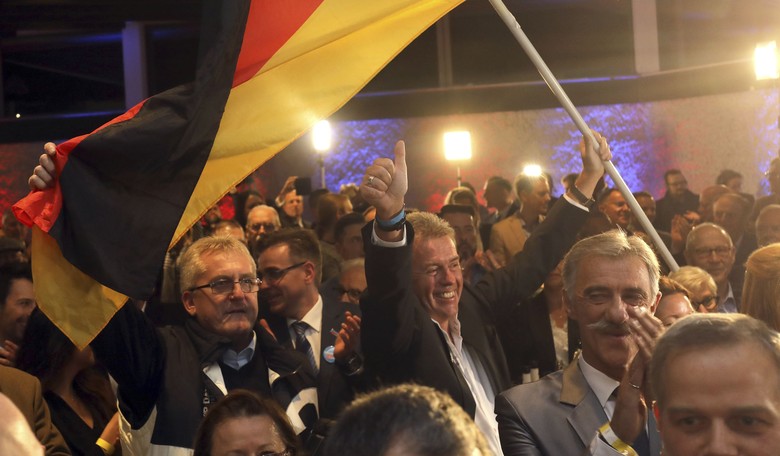
It was a local election, but one that shook Germany’s political establishment to its core. Is it a preview of what could happen in the next round of federal elections? Who knows. These so-called right-wing insurgencies in Europe burn bright but usually die fast. We shall see, but for now, the Alternative for Germany in Sunday’s Saxony-Anhalt hit Chancellor Frederich Merz hard, though he vowed to keep pushing unpopular policies—my dude, this is why the AfD won. The firewall — the German political creed regarding parties never working with those deemed extremist — could be on the chopping block (via NYT):
That argument now faces its biggest test in the wake of Sunday’s election in Saxony-Anhalt, a small state of 2.1 million people in the east that broke decisively for the far-right Alternative for Germany party, or AfD.
The result was an example of a fundamental disagreement among Germans about what constitutes a risk to democracy. Voters were asked by pollsters on Sunday if they considered the AfD a danger to democracy, as Germany’s mainstream parties do. About half saw the AfD as a threat, according to exit polling released by a public television network. They voted almost exclusively for its rivals, from the far left to the center right.
The other half of voters said there was no threat.
Nearly all backed the AfD.
It was a vivid illustration of the growing divide between Germany’s mainstream parties, which govern from the center-right and the center-left, and populist voters who have grown convinced that politics as usual can no longer solve their urgent problems.
[…]
To the AfD’s supporters, particularly in the country’s economically struggling eastern states, the AfD has become a last, best shot for making their voices heard — a feeling only reinforced by governing parties’ refusal to work with it.
Those voters express anxieties over high levels of immigration from the Middle East over the last decade and a series of deadly attacks by immigrants across Germany in recent years. They complain about high prices for electricity and fuel and dim job prospects, and they still harbor resentments from their treatment by western Germans after the country reunified in 1990.
They say they are less worried that the AfD might infringe on some Germans’ rights, and more concerned that mainstream parties are silencing AfD voters.
[…]
The final vote tally in Saxony-Anhalt showed a dominant AfD performance, but no guarantee it will govern. The party won just under 44 percent of the vote amid record turnout, and 39 seats in an 83-seat Parliament. Even coming from a relatively small state nestled in the AfD’s eastern power base, the result jolted German politics and shook the concept of a firewall — at a time when the AfD leads national polls.
Roger Stöcker, a political scientist at Otto von Guericke University in Magdeburg, called it “a historic turning point.”
The catch is who will work with the AfD. In a nation where coalition governance is the norm, what’s going to happen? Because Merz’s Christian Democratic Union Party, which is not all that popular in the eastern states, seems open to working with AfD lawmakers at the local level. Merz thus far has vocally opposed any cooperation with the AfD (via WSJ):
This leaves Merz, who is also CDU chairman, with two options.
He could insist on the CDU sticking to the firewall and working to form an anti-AfD state government with Green lawmakers, Social Democrats, former Communists and even far-left populists.
There is strong resistance to this scenario among CDU state lawmakers. A rebellion against the chancellor could leave his authority permanently damaged. With the worst popularity ratings of any postwar chancellor, his standing in the party is already diminished.
Merz could instead give the state CDU free rein to deal with the AfD. This too could fracture his party and would likely spell the end of his coalition government. His ruling partner, the center-left Social Democratic Party, has categorically opposed any form of cooperation with the AfD.
While it took place in one of Germany’s smallest states, the election marks a new milestone in the shrinking of the political center that has made Europe’s largest economy ever harder to govern. The CDU halved its 2021 score in the state. Nationally, the party is between five and six points behind the AfD, which has increased its lead recently as Germany’s most popular party.
The AfD’s populist agenda includes speeding up the deportation of undocumented migrants, increasing welfare benefits for native-born Germans, ending sanctions on Russia and German aid to Ukraine, and pulling the country out of the European Union. It is among the most radical of the nationalist parties that have been ascendant in Western Europe in recent years.
Many of its policies are beyond the powers of a state government. Yet the AfD has pitched the election as a chance to show it can successfully implement policies outside of the mainstream consensus that has endured in the postwar era.
Let's see what happens.