
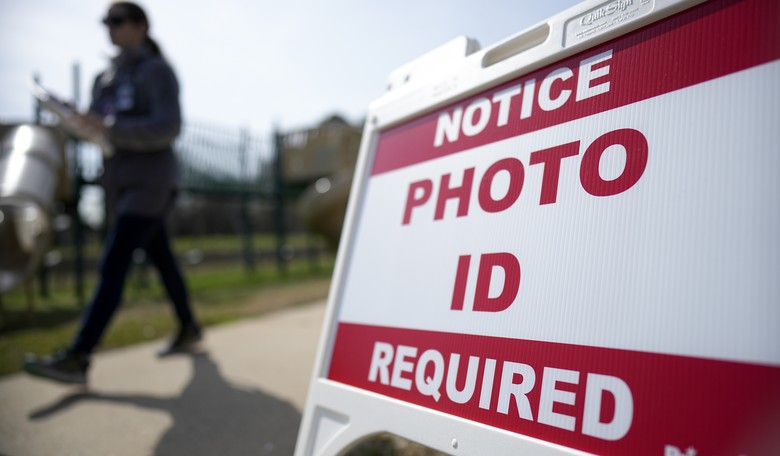
Only citizens are allowed to vote in federal elections. That should not be a controversial statement — yet the Ninth Circuit’s ruling in Mi Familia Vota v. Fontes makes it harder for Arizona to enforce that basic safeguard. This week, the American Center for Law and Justice (ACLJ) filed an amicus brief at the Supreme Court in this case, urging the Court to reverse a decision that undermines the security and accuracy of Arizona’s voter rolls. Our brief was on behalf of both our supporters and Representative Eli Crane (AZ-2), someone concerned with ensuring federal elections are protected.
At issue is Arizona’s requirement that voters provide documentary proof of citizenship, Voter ID, before registering to vote in elections, along with the state’s process for confirming — and, where necessary, canceling — the registrations of voters who identify themselves as noncitizens. The Ninth Circuit held that the National Voter Registration Act (NVRA) preempts both requirements. We filed our brief because that ruling strips Arizona of tools it needs to keep its voter rolls accurate, and we’re asking the Supreme Court to reverse it.
Sign our petition: Defend Election Integrity and the Constitution.
Confirming that a voter is actually a citizen before they cast a ballot for president, Voter ID, is not some novel imposition — it is the baseline check that keeps an election trustworthy. The Supreme Court has already recognized that it would raise serious constitutional problems if a federal statute stripped a state of the ability to obtain the information it needs to enforce its own voter qualifications. Arizona is doing exactly that: confirming citizenship before adding a name to the rolls.
The lower courts got it wrong. The NVRA was meant to make voter registration easier while still allowing states to keep their voter rolls accurate and secure. It was not meant to force Arizona to accept registration forms when the state has no reliable way to confirm whether the applicant is eligible. Federal law allows Arizona to ask for the information it needs to make that determination, and there has to be a real conflict between state and federal law before a court can strike down Arizona’s safeguard — not just a preference for a weaker one.
The same is true of Arizona’s process for canceling registrations when voters identify themselves as noncitizens. The NVRA’s “Quiet Period” rule is meant to stop broad, last-minute voter purges in the 90 days before a federal election — the kind of mass removals that can mistakenly take eligible voters off the rolls. Arizona’s law is different. It requires notice, confirmation, and a chance to respond before anyone’s registration is canceled. That is a careful, voter-by-voter process designed to prevent ineligible voting without sweeping eligible voters off the rolls. Courts have repeatedly allowed this kind of individualized review because it protects both election integrity and eligible voters.
That is the balance the NVRA was designed to protect: more eligible citizens registered, and the rolls kept accurate along the way. A ruling that allows the NVRA to block Arizona from verifying citizenship or removing ineligible registrants doesn’t advance that goal — it defeats it.
That is why the ACLJ and Representative Crane filed this brief, and why we will keep defending election integrity before the Supreme Court: Every ballot cast by an ineligible voter cancels out the vote of an eligible one, and the Constitution does not require Arizona to look the other way.
Take action with the ACLJ. Sign our petition: Defend Election Integrity and the Constitution.