
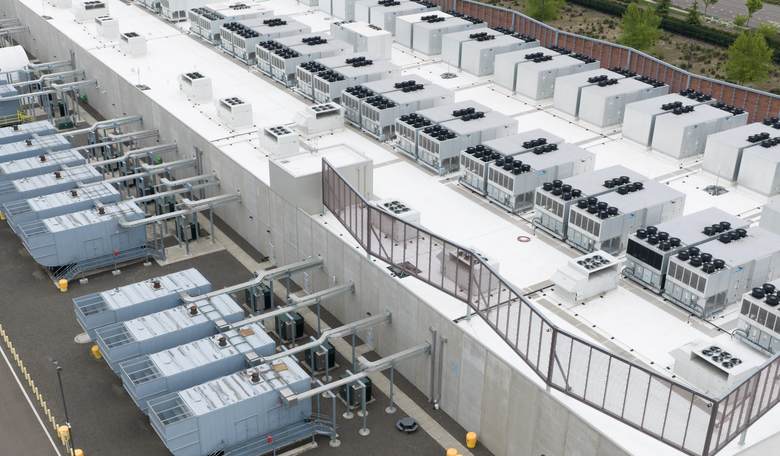
What jobs do data centers actually create?
It is a question increasingly on Americans’ minds as public opinion turns against data centers, their construction, environmental footprint, energy and water use, and uncertain local economic benefits. Yet in an era when President Trump has promised to reindustrialize America, many people are asking a simpler question: what good jobs will these facilities actually provide?
First, it is important to remember that jobs should not be the primary metric for evaluating any infrastructure project. Treating them as such is reminiscent of the public-works programs of the 1930s under FDR, when the focus often shifted away from building what people needed, toward employing as many people as possible. Conservatives should understand that a jobs program is not the purpose of economic development.
Second, it is wrong to assume data centers, by themselves, must be massive job creators to justify their existence. The same criticism could be leveled at power lines, nuclear reactors, bridges, and other essential infrastructure projects. It may be technically true that they employ relatively few people once complete, but it also misses the point entirely.
Similarly, you could claim electrical power lines provide no jobs, or that refrigerators provide no jobs, or that computers provide no jobs. It would, of course, be ridiculous, but you could claim it. https://t.co/vaND6rqT23
— Perry E. Metzger (@perrymetzger) August 24, 2026
Now, onto the jobs data centers do, in fact, provide.
The answer begins with construction. Building a large data center requires electricians, plumbers, HVAC technicians, heavy-equipment operators, steelworkers, concrete workers, engineers, project managers, security personnel, and other skilled trades. Those jobs are temporary, but major projects can take years to complete and can employ hundreds or thousands of workers across the life of the build. Construction is, in fact, where most of the immediate employment effect occurs.
Now, onto the more disputed question of long-term jobs. Data centers do create permanent local employment, even if they are not labor-intensive in the manner of an old-fashioned factory. A Brookings analysis found that, over the first decade after a county receives its first large data center, employment in data processing rose 56 percent and employment in telecommunications rose 43 percent. In a typical county, those gains translate to roughly 100 to 200 additional jobs, depending on the type of facility.
The permanent jobs are also quite varied. Data centers need data-center technicians to install, test, repair, and maintain servers; network engineers and fiber technicians to keep enormous volumes of data moving; electrical and mechanical technicians to maintain generators, batteries, and power-distribution equipment. They need HVAC and cooling-system specialists to keep equipment from overheating; critical-facilities engineers and chief engineers to oversee the site’s core systems; operations managers; logistics and inventory personnel; and physical-security staff. Major operators also hire cybersecurity specialists, safety professionals, contractors, and vendor-management personnel to keep a facility reliable around the clock.
That covers the jobs inside the data centers themselves. What is discussed far less often is the broader employment these facilities can make possible across the technology sector, and across the economy as a whole. As computing capacity becomes more available, startups can build products that would otherwise be too expensive or too difficult to launch. Established companies can create new AI teams, develop new products, and take on projects that previously would not have made economic sense. That means more work not only for software engineers, data scientists, product managers, and cybersecurity specialists, but for the electricians, plumbers, construction workers, equipment technicians, and other tradesmen needed to build and sustain the infrastructure behind that growth.
The jobs a data center provides must be measured beyond the workers immediately inside the physical building. The benefits are broader and longer-term, even if much of the public debate is understandably focused on the immediate disruption: the construction, the land use, the power demand, and the number of local people hired on day one.
Of course, none of this means AI will leave every already existing job untouched. It will automate certain tasks, eliminate some roles, and force workers and companies to adapt to a new economy. But that has been true of every new technology. The relevant question is whether America will build the infrastructure, develop the skills, and create the new industries needed to turn that disruption into greater productivity and broader opportunity.
A data center may not resemble a mid-century factory, with thousands of workers clocking in every morning to work an assembly line. But that is because the economy is changing, not because these facilities are useless. If AI is the next industrial revolution, then data centers are among the factories of that revolution, the infrastructure that makes a new generation of products, companies, and industries possible. The question should not be whether every data center creates the same kind of jobs as a factory did in 1955. It plainly does not.
The question is whether America wants to build the capacity to lead in the industries of the future, or allow fear of change and an outdated definition of “good jobs” to leave that work, that investment, and that leadership to someone else.