
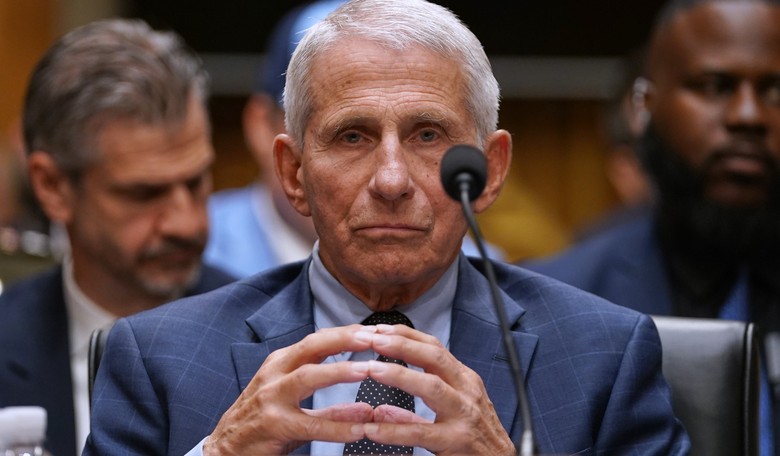
David Morens spent nearly two decades as Anthony Fauci's most trusted adviser at NIAID. Last Tuesday, in a federal courtroom in Greenbelt, Maryland, he stood up and told a judge he'd conspired to defraud the United States government. He's facing up to five years in prison, with sentencing set for November 12. The confession came a little over five years after the conduct itself. It arrived roughly 19 months after Joe Biden signed the pardon that made sure his old boss never had to answer for any of it.
The real story here is what happens when the man taking orders finally admits guilt after the man giving them already got immunity. Morens just handed the country a signed receipt for a cover-up. Fauci got his get-out-of-jail-free card on January 19, 2025, the day before Donald Trump took the oath of office, wrapped inside Biden's stack of preemptive pardons for loyal aides and family alike.
Here's what Morens actually admitted to, according to the Justice Department. After NIH terminated EcoHealth Alliance's bat coronavirus grant, Morens and two co-conspirators, one of them identifiable as EcoHealth's Peter Daszak, agreed in writing to route their communications through Morens's personal Gmail account instead of his government email, specifically to keep them out of reach of FOIA requests. They used that channel to trade nonpublic NIH information, draft letters lobbying agency leadership on EcoHealth's behalf, and “back-channel” information to a senior NIAID official the documents don't name but everyone in Washington can. Daszak sent Morens wine as thanks for his “behind-the-scenes shenanigans” and dangled Michelin-starred dinners in Paris and New York. Morens later suggested he'd earned the wine by helping place a medical-journal commentary arguing COVID-19 had natural origins, not a Wuhan lab pedigree. This is the Justice Department's own account, not a talk-radio theory.
Now layer in the paper trail Senator Rand Paul's committee surfaced last September. Fauci told the House Oversight Committee under oath in 2024 that he'd never deleted an official record, never obstructed a FOIA request, and never touched anything related to the Wuhan lab or the virus's origins. Then the emails came out. On February 2, 2020, Fauci told NIH Director Francis Collins, “Please delete this e-mail after you read it.” Five months later, writing to his own chief of staff about a subject he wanted buried, he asked the man to delete that message too, once he'd finished reading it. Those aren't my characterizations. They're his own words, on paper, contradicting his own sworn testimony.
I've spent 30 years as a designated expert witness in federal and state courts, cross-examined by lawyers whose entire job is finding the gap between what a witness swore to and what the record actually shows. When that gap opens up in my line of work, it doesn't stay open long. Somebody gets impeached, sanctioned, or referred for perjury. Fauci got a pardon that covers any federal crime he “may have committed” going back to 2014, broad enough to swallow whatever a records investigation might eventually turn up. He never had to sit for that cross-examination.
To be fair, nobody has charged Fauci with anything yet, and the Washington Post reported plainly that he isn't accused of wrongdoing in the Morens case itself. That's a fact, and I won't pretend otherwise. It's also worth remembering that Morens, Daszak, and the still-unnamed second co-conspirator are the ones who signed the plea papers, not Fauci, and a signed guilty plea is a higher standard of proof than a Senate letter or a cable news chyron. But that fairness cuts both ways. A pardon covering conduct dating back to 2014 is exactly the kind of shield a prosecutor would need to see through before ever bringing a case, and that's precisely the point of a preemptive pardon. It doesn't wait for an indictment because it's designed to make them irrelevant. Hunter Biden's federal gun conviction was already on the books when his father pardoned him, so calling that one a break from the law is simple arithmetic. Fauci's pardon shielded him from accusations that had never gotten anywhere near a courtroom, which is a different and, in some ways, more troubling use of the power. One card covered a proven conviction. The other covered every question nobody had gotten to ask yet.
Consider the timing. Fauci swore under oath in June 2024 that his hands were clean. Seven months later, Biden’s autopen covered him for anything that testimony might not survive. By September 2025, Rand Paul's committee had the emails contradicting that testimony and demanded he come back and explain himself. By August 2026, his own former right-hand had pleaded guilty in federal court to running the very concealment scheme those emails documented. Every domino in that chain fell exactly where a careful observer would expect, except the one domino everyone actually wanted to see fall. That one had already been removed from the table before it got its turn.
None of this restores the trust his agency abused during the pandemic, and none of it will. But it does settle an argument I've heard from more even-keeled friends for years, the one that says the lab-leak suppression story was partisan noise. It wasn't. It was federal employees admitting, under oath, in a federal courtroom, to a scheme built for the specific purpose of keeping the public from seeing how the sausage got made. Morens confessed. The paper trail is public. The only man who never has to answer for any of it is the ringleader who signed his own subordinate's marching orders and then let a president's pardon pen finish the job.
The card's already been played. The rest of us just get to watch the clock run out on November 12 and ask why the wrong man is the only one facing it.
Jay Rogers is a financial professional with more than 30 years of experience in private equity, private credit, hedge funds, and wealth management. He has a BS from Northeastern University and has completed postgraduate studies at UCLA, UPENN, and Harvard. He writes about issues in finance, constitutional law, national security, human nature, and public policy.