
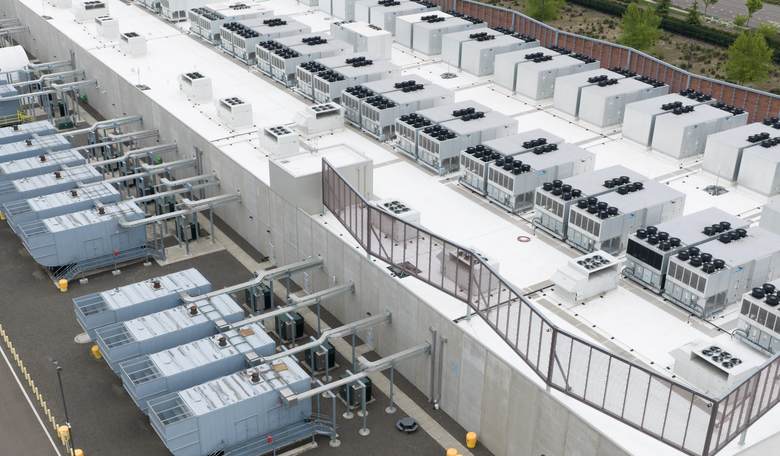
Welcome to the most successful misinformation campaign America has ever seen.
Ask Americans whether they would accept a traditional manufacturing plant, an Amazon distribution center, or a semiconductor factory in their community, and most would say yes. But turn that project into an AI data center, despite its role in powering the technologies increasingly central to the modern economy, not to mention people's everyday lives, and public support suddenly collapses.
The absurdity is difficult to overstate: more Americans even say they would rather have a nuclear power plant in their neighborhood than an AI data center.
Americans would rather have a nuclear power plant built in their community than a data center, this may be the worst corporate public-relations fumble of all time pic.twitter.com/vQnq37ernc
— Christopher F. Rufo ⚔️ (@christopherrufo) August 18, 2026
According to a March Gallup poll, 68 percent of Americans would support an Amazon distribution center in their community. Sixty-seven percent would support a traditional manufacturing plant, and 49 percent would welcome a semiconductor plant. But when asked about an AI data center, a facility that can generate more tax revenue, create less local disruption, and attract substantially more investment, support falls to just 27 percent.
The preference seems almost backwards. Each of these projects can bring real economic value to a local community, yet the project that is often least disruptive, and potentially the most financially beneficial, has become the least popular.
A factory or Amazon distribution center can bring a near-constant flow of semitrailers, loading docks operating around the clock, shift changes, road congestion, noise, and hundreds or even thousands of daily commuters. A data center, once construction is complete, is largely the opposite: a secure, low-traffic facility with minimal permanent staffing, little rush-hour congestion, and far fewer ongoing demands on roads and municipal services. Yet it can still provide one of the largest tax bases of virtually any major infrastructure project.
How did a cornerstone of the future American economy become so badly misunderstood?
Big Tech’s already deep reservoir of public distrust has certainly contributed. But so has the reflexive refusal to engage with evidence about what data centers actually do, what they cost, and what they contribute to the communities that host them. Despite substantial evidence to the contrary, concerns about water use, rising electricity prices, limited local economic benefit, and environmental damage continue to shadow data-center construction. Those fears have already prompted at least three states to impose heavy restrictions, with many more appearing to move in the same direction.
Local communities should absolutely retain the right to decide what is built in their own backyards. But when so much of the opposition rests on inaccurate or incomplete information, it is worth asking whether the concern is truly grounded in reality, or simply the result of a remarkably successful fear campaign.
The irony is that many data centers are, in effect, massive supercomputers: facilities that house the hardware and computing capacity necessary to power AI. People have joked that if they were simply called “supercomputers,” public opposition might entirely evaporate. It is a joke, but it exposes how much of the public backlash may rest on branding and PR rather than any real substance.
This is exactly what misinformation does. It recasts productive investment as a public threat, private companies as villains, and essential infrastructure as something communities should fear. Americans demand growth, lower costs, and technological leadership, and then oppose the facilities required to deliver all three.
A free-market economy cannot thrive when every major private technology investment is presumed exploitative before the evidence is even considered. Data centers should be judged on their actual local tradeoffs, not reflexive fear, resentment, or a PR narrative so effective that Americans now prefer nearly any other form of development to the supercomputers powering the future.