
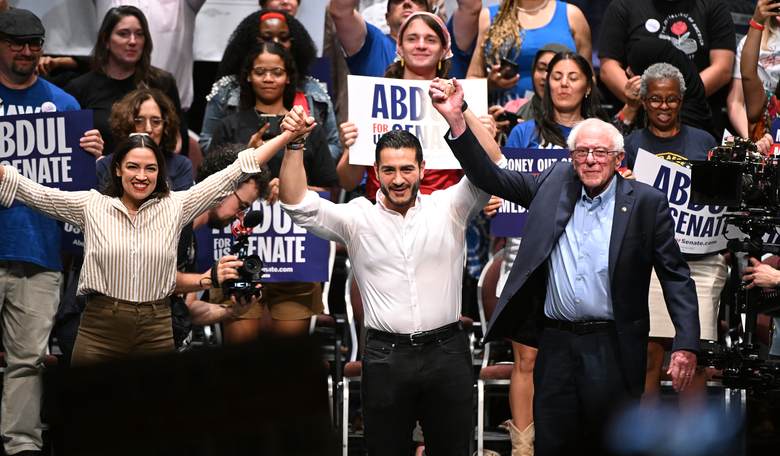
It was a long night for some folks watching the Michigan primary. Abdul El-Sayed won, narrowly defeating Rep. Haley Stevens. In the end, AES came out ahead by less than a point. It was a far cry from the Battle of Hattin-like slaughter pollsters and pro-AES folks were chirping about in the waning days of the campaign. The entire slate of polls was not good, which Nate Silver pointed out with his 11 observations.
He did note that this is a significant win for the far left, regardless of everything, considering that AES’s most recent move into public life was a 22-point defeat at the hands of Gretchen Whitmer. There shouldn’t be any talk of Stevens being a poor candidate; she was elected to four terms from her district with strong margins. Unfortunately, she needed to boost her support in her home county of Oakland but faced a problem: wealthy white suburbanites developing a case of neo-Trotsky fever. This faction within the Democrat Party is increasingly shifting to the left and becoming more unhinged. Polling the anti-El-Sayed vote will be difficult since it mostly consists of black working-class and rural voters. Silver mentioned that while progressives are gaining strength, Democrats are not yet in ‘bend the knee’ territory; for example, Cori Bush lost her bid for a political comeback in Missouri. That last point may be a bit optimistic [emphasis mine]:
- We should start by acknowledging that an El-Sayed win by any margin is a significant accomplishment. It’s not exactly surprising, given the success of more progressive candidates elsewhere and that he’s been ahead in the polls for a couple of months now. But this is a guy whose only previous attempt at elected office resulted in a 22-point loss to Gretchen Whitmer in the 2018 Michigan gubernatorial primary. Michigan, where I’m from, isn’t New York City or some super liberal district in Colorado. This is a big W for progressives in a purple state.
- With that said, I think AES and some of his supporters are guilty of managing expectations very poorly. Some of the polls I mentioned were from firms affiliated with El-Sayed’s campaign. I don’t understand the utility of publishing internal polls showing yourself ahead by double digits — personally, if I ran a campaign, I’d make it a strict policy to never release internal polls, which are often highly misleading. And if you’re going to do that, you probably ought to come closer than within ~10 points of the actual result. El-Sayed has also predicted a big win for himself against Mike Rogers, who won the Republican nomination uncontested tonight, but who is a relatively moderate Republican for the Trump Era. As someone who can be a little trollish himself, and is sometimes accused of being cocky, I’ve kind of vibed with AES’s confidence on some level, but I’m also not running for office and would be a terrible candidate if I did.1
- […]
- Instead, a very narrow AES win is in the sweet spot of the “second-guessing zone” for the Democratic establishment. Instead of accepting that they have a lot of problems, they’re going to ask what they might have done differently. Mallory McMorrow actually got 4 percent of the vote despite dropping out (so El-Sayed isn’t likely to hit 50 percent). What if she had endorsed Stevens? Or what if she had been the nominee? With some very notable exceptions such as Michigan Gov. Gretchen Whitmer, a lot of the Democratic establishment, including Michigan incumbent Sen. Elissa Slotkin, stayed on the sidelines in the race.2 I don’t necessarily know that their endorsements would have helped Stevens, especially since a lot of El-Sayed’s rhetoric was about how the Democratic establishment, AIPAC and wealthy donors had been putting a heavy finger on the scale.3 But the establishment might regard this as a game in which they took the starters out at halftime, and almost won anyway, rather than one they were destined to lose the whole time.
- It’s clear that progressives are rising in the Democratic Party overall. But it’s also clear that there’s a fair amount of race-by-race variance. Just tonight, in Missouri’s 1st congressional district, former Squad member Cori Bush lost to a moderate Democrat by 22 points in a comeback bid, while one of the most moderate Democrats in the House, Marie Gluesenkamp Perez, easily advanced to the general election in Washington’s 3rd district. Roy Cooper is the Democratic nominee in North Carolina, and that hasn’t been particularly contentious. The media likes simple narratives, and “progressives rising” is by no means wrong, but nobody should be bending the knee at this point.
- With that said, there’s a fair amount of cope in establishment circles too. Stevens loses? Well, a lot of establishment types will just assert that she was a bad candidate. Andrew Cuomo? Bad candidate. Janet Mills? Bad candidate. These things are rarely so obvious in advance, though. Stevens won election to the House four times in a suburban Detroit district with perfectly normal margins, for instance.
- […]
- Further, the whole trajectory of polling in this race was weird. At one point, the McMorrow campaign successfully pressured a small news outlet into quashing a poll that showed them way behind. At another point, El-Sayed falsely accused a different pollster that had Stevens narrowly ahead of having been funded by AIPAC. Many of the pollsters in this race have mediocre pollster ratings, aren’t rated at all because they’re new, or aren’t used by Silver Bulletin because they don’t meet our standards for professional polling firms. There can sometimes be cases of the blind leading the blind in polling, producing a lot of herding toward a sometimes very wrong consensus. The constant, frankly often very amateurish “discourse” about polling on Twitter and elsewhere on social media doesn’t help matters either. There are fewer and fewer pollsters I trust to do their own thing, instead of being influenced by “the narrative”.
- With that said, Congressional primaries are hard to poll, and Michigan is a particularly hard state to poll for various reasons. Among them: a) Stevens’s best groups were probably rural white voters and working-class Black voters, two groups that are notoriously hard to reach in surveys; b) AES was counting on big turnout from younger voters, but they often don’t turn out in big numbers in primaries; c) I think it’s pretty clear that AES had the more enthusiastic supporters, but this is a mixed indicator because of non-response bias: more enthusiastic voters might be more likely to vote, but may also be proportionately even more likely to participate in surveys when what you might call “Shy Stevens” voters don’t; d) Michigan has a reasonably large Arab-American population, but not large enough to yield a reliable crosstab in (say) a 600-person survey, so instead Arab-Americans routinely fall between the cracks in opinion research.
- Tonight is probably bearish for Democrats in the general election, but I wouldn’t overstate that. I’ve always thought people are too eager to derive implications about general election strength from primary results. Part of the reason that Democratic voters are moving to the left is that moderate voters are leaving the party, and AES will need to win them in the general election. If you’re a Silver Bulletin reader who happens to be a Democrat, one positive would be if El-Sayed takes tonight’s results as a signal that he needs to be more conciliatory between now and November.
Yeah, I don’t think he’s going to moderate, Nate. I know that’s the logical play, but this operation is fraught with well, folks who are not that.