
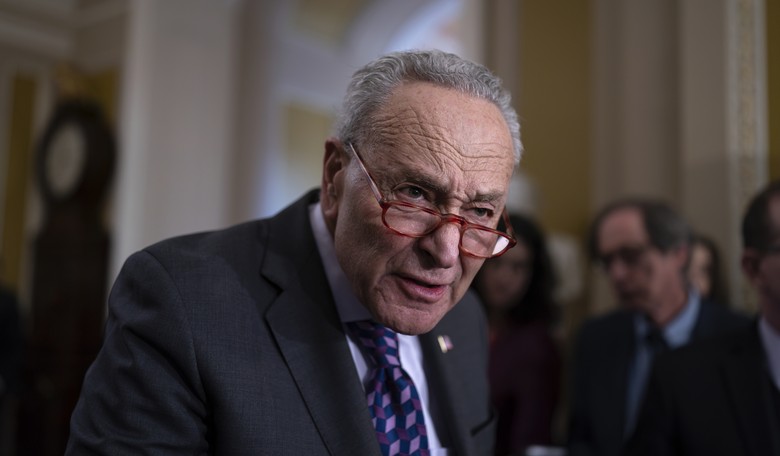
Members of the United States Senate signed the "oath book" to assume the role of jurors on Wednesday afternoon, set to begin the impeachment trial for Homeland Security Secretary Alejandro Mayorkas. After the formal process of convening a court of impeachment, however, Senate Majority Leader Chuck Schumer (D-NY) addressed the upper chamber and confirmed he would attempt to prevent the trial from taking place.
The norm-breaking, duty-abdicating move by Schumer and Senate Democrats upsets 227 years of congressional history.
In his remarks from the Senate floor, Schumer said he would make two motions, one to dismiss each of the two articles of impeachment passed by the House earlier this year: the first article deals with the DHS secretary's "willful and systemic refusal to comply with the law" and the second article addresses Mayorkas' "breach of public trust."
The majority leader said seven points of order would be allowed on the motion to dismiss the first article but only one point of order would be allowed on the motion to dismiss the second article. Both motions would have 60 minutes of debate, Schumer outlined. Schumer said he would then move to adjourn the court of impeachment with just four minutes of debate on that question.
Schumer then raised a point of order to claim that the first article of impeachment against Mayorkas does not allege conduct that rises to the level of a high crime or misdemeanor and is therefore "unconstitutional," an ironic attempt to claim adherence to the Constitution in order to abdicate the Senate's constitutional duty.
Unable to debate Schumer's point of order while operating under the rules for a court of impeachment, Republicans attempted to find a procedural method to allow for the merits of Schumer's claim to be debated. Here's how things unfolded:
- After a quorum was established, Senator Ted Cruz (R-TX) made a motion to move into a closed session which failed 49-51.
- Senator John Kennedy (R-LA) next rose to make a motion to adjourn the court of impeachment until April 30, allowing normal rules and debate to take place in the mean time and save the trial from being torpedoed by Schumer on Wednesday. That motion also failed 49-51.
- Republican Leader Mitch McConnell (R-KY) then made a motion to table Schumer's point of order about the first impeachment article's constitutionality, another move that failed 49-51.
- The Senate eventually approved Schumer's point of order claiming the first article of impeachment against Mayorkas is "unconstitutional" in a party line 51-48 vote — Senator Lisa Murkowski (R-AK) voted present — killing the first article against Mayorkas.
Article I falls.
— Senate Cloakroom (@SenateCloakroom) April 17, 2024
- Schumer then made the same point of order claiming that the second article is also unconstitutional, and the Republican side, via Senator Mike Lee (R-UT) again made a motion to proceed to a closed session. The attempt to stop or at least slow Schumer's plan to dispense with the impeachment trial failed 49-51.
- Senator Rick Scott (R-FL) then made another motion to adjourn the court of impeachment until April 30. It too failed 49-51.
- Rising again on the Senate floor, Sen. Kennedy moved to adjourn the impeachment court until May 1, but that motion was defeated 49-51.
- Another unsuccessful attempt to adjourn was made by Senator Roger Marshall (R-KS) who moved for a delay until November 6 "so the American people can at least have a vote on this impeachment trial" but another party-line vote defeated the motion 49-51.
- Sen. Kennedy next made a motion to proceed to an executive session, but it too failed 49-51.
- Republican Whip John Thune (R-SD) tried again to table Schumer's point of order on the constitutionality of the second article of impeachment against Mayorkas. The motion failed 49-51.
- The Senate then proceeded to vote on Schumer's point of order and approved it 51-49, killing the second article of impeachment against Mayorkas.
Article II falls.
— Senate Cloakroom (@SenateCloakroom) April 17, 2024
The senate then voted to adjourn the court of impeachment, prematurely ending Mayorkas' saga.
Senate Democrats effectively declared Mayorkas innocent without a trial, made it clear that they don't believe a felony rises to the level of a "high crime or misdemeanor," and set a precedent that means future administrations no longer need to give a thought to congressional accountability whenever they control the upper chamber.
Last Update: 4:29 p.m. ET
ORIGINAL POST—
Last week, 43 Republican members of the United States signed a letter to Schumer highlighting the upper chamber's "constitutional duty" that "requires the Senate to hold a trial."
"In every previous congressional impeachment of the past 227 years, Congress has been faithful to the process set out by the framers," the letter emphasized. "Never before has the Senate abandoned this duty, even when certain members believed the basis for impeachment was tenuous at best."
"Since 1797, twenty-one individuals have been impeached by the House of Representatives," the Senate Republicans' letter further recounted. "Trials were held in every single instance, except once when an impeached judge resigned from office before trial commenced. Absent Secretary Mayorkas’ immediate resignation, this impeachment should remain faithful to Senatorial precedent," senators wrote.
Schumer however, for purely political reasons, rejected that history and breached constitutional duty to deny Americans the trial they are owed in an effort to protect President Biden from accountability for his out of control border disaster.
This is a developing story and will be updated.