








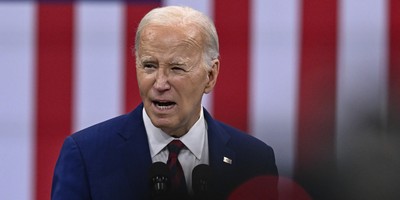

Barack Obama chose St. Paul, Minn., to stage his victory or at least near-victory rally Tuesday night. It was a good way to stick a thumb in John McCain’s eye, since the Republicans have chosen to hold their national convention at the same arena.
Yet he overlooked the historical connotations of that site. Beautiful downtown St. Paul is where Walter Mondale delivered his concession speech after one of the most lopsided defeats in the history of American presidential elections: Ronald Reagan’s 49-state sweep in 1984.
For his last hurrah of the primary season, he chose a place associated with one of his party’s great defeats. It’s as if admirers of George Armstrong Custer were to gather at Little Bighorn, aka Custer’s Last Stand, to proclaim victory.
It’s no a big matter. The de facto Democratic presidential nominee had good reason to choose a battleground state and a battleground region for his big rally. But the choice also fits into a larger, unsettling pattern: The young senator seems tone-deaf to history.
For another example, he invoked the memory of John F. Kennedy in defense of his sweeping offer to meet the world’s most dangerous leaders ? like Iran’s Mahmoud Ahmadinejad and North Korea’s Kim Jong-Il ? with no conditions attached. After all, he noted, hadn’t President Kennedy met with Soviet boss Nikita Khrushchev early in his administration?
To quote Senator Obama: “If George Bush and John McCain have a problem with direct diplomacy led by the president of the United States, then they can explain why they have a problem with John F. Kennedy, because that’s what he did with Khrushchev.”
He did it in Vienna in June of 1961, to be exact, and Nikita Sergeyevich sized up the young president at once. His considered opinion: “too intelligent and too weak.” It was just like First Secretary Khrushchev to equate intelligence with weakness. One of his aides was equally blunt: “Very inexperienced, even immature.”
In short, that meeting in Vienna - without proper preparation or any preconditions - proved “just a disaster,” to quote JFK’s assistant secretary of defense, Paul Nitze. The president himself agreed, telling the New York Times’ Scotty Reston immediately afterward that his meeting with the Soviet ruler had been the “roughest thing in my life.”
Comrade Khrushchev drew the logical conclusions from his meeting with the new American president: The guy was a pushover. The Berlin Wall went up that August, splitting the city and creating a focal point of tension and violence for decades.
Then he decided to tilt the whole global balance of power to the Soviet Union’s advantage by installing nuclear-tipped missiles in Cuba. Which he proceeded to do with Fidel Castro’s enthusiastic, not to say bellicose, cooperation. Or as Nikita Khrushchev put it in his always refined way, it was time to “throw a hedgehog at Uncle Sam’s pants.”
The result was the Cuban Missile Crisis of 1962, the closest the world has come to nuclear holocaust. By then John F. Kennedy had learned a thing or two; he never deigned to negotiate with Fidel Castro, and he made it clear from the outset that a nuclear attack on this country from Cuba would be met as if it had originated in Moscow, as indeed it would have.
After a long, elaborate, and nerve-wracking diplomatic dance, complete with a naval embargo of Cuba and many a crisis within the crisis, the missiles were removed. Things had worked out somehow. But it was still, as the Duke of Wellington said of Waterloo, a damned close-run thing ? much too close for comfort. And it had its origins in an ill-considered meeting without proper preparation.
And this is the meeting Sen. Obama uses to justify his open-ended, no-conditions offer to meet with some of the most fanatical anti-American leaders in the world, at least one of whom - Iran’s nutcase president - has been trying to acquire a nuclear arsenal for years. (And he’s making good progress to the regular accompaniment of irresolute UN resolutions against a nuclear-armed Iran.)
Let it be noted that, by the time John F. Kennedy went to Vienna, he’d already served six years in the House and eight in the Senate. A combat veteran and war hero, he’d spent more time in the Navy than Barack Obama, a freshman senator, has spent in the U.S. Senate. And he was still blindsided at Vienna.
By now Sen. Obama has backtracked slightly on his offer to meet the Mahmoud Ahmadinejads and Kim Jong-Ils of the world with no preconditions. Which is a welcome development. But that he should use a young president’s diplomatic blunder as an example to emulate. … Well, it does not encourage confidence in his judgment. To put it mildly, it betrays a marked insensitivity to the lessons of history. Which is troubling.
Join the conversation as a VIP Member